
VGA = Video Graphics Array
VGA, introduced by IBM in 1987, is the analogue video interface long used between PCs and their monitors. The 15-pin high-density D-sub connector (DE-15, commonly called HD-15) carries three analogue colour signals (red, green, blue) at 0.7 V peak-to-peak into 75 ohm, separate horizontal and vertical sync, and — on later cards — a DDC (Display Data Channel) I²C link on pins 12 and 15 that lets the computer read the monitor’s capabilities. Higher-resolution timings (SVGA and beyond) reuse the same connector.
Videotype: analogue. VGA (31.5 kHz - 640x480) SVGA (35-37 kHz - 800x600)
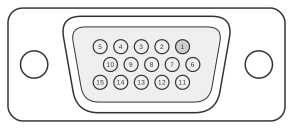 15 PIN HIGHDENSITY D-SUB FEMALE at the videocard
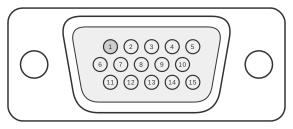 15 PIN HIGHDENSITY D-SUB MALE at the monitor cable
| Pin | Name | Dir | Description |
|---|---|---|---|
| 1 | RED | OUT | Red Video (75 ohm, 0.7 V p-p) |
| 2 | GREEN | OUT | Green Video (75 ohm, 0.7 V p-p) |
| 3 | BLUE | OUT | Blue Video (75 ohm, 0.7 V p-p) |
| 4 | ID2 | IN | Monitor ID Bit 2 |
| 5 | GND | - | Ground |
| 6 | RGND | - | Red Ground |
| 7 | GGND | - | Green Ground |
| 8 | BGND | - | Blue Ground |
| 9 | KEY | - | Key (No pin) |
| 10 | SGND | - | Sync Ground |
| 11 | ID0 | IN | Monitor ID Bit 0 GND=Color; NC=Mono |
| 12 | ID1 or SDA | IN | Monitor ID Bit 1 NC=Color; GND=Mono Some systems only uses ID0 for monitor ID |
| 13 | HSYNC or CSYNC | OUT | Horizontal Sync (or Composite Sync) |
| 14 | VSYNC | OUT | Vertical Sync |
| 15 | ID3 or SCL | IN | Monitor ID Bit 3 |
Notes
- Direction is Computer relative Monitor