
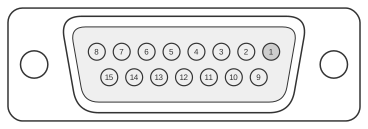
 Apple Studio Display 15 - 15 pin DSUB Connector
The Apple Studio Display 15-inch LCD (1998, Revision A) uses a 15-pin DA-15 connector for its primary RGB video input, carrying separate red, green, and blue analogue signals together with horizontal and vertical sync lines. The DA-15 was the standard external video connector on Macintosh desktop computers from the Macintosh II (1987) through the beige Power Mac G3 (1998). Monitor identification is handled via three sense lines (ID1/ID2/ID3, corresponding to SENSE0/SENSE1/SENSE2), governed by Apple Technical Note HW30 (September 1992), which defines the 3-bit and Extended Type-7 dynamic polling protocols. Revision B of this display simplified the connection to a standard DE-15 (HD-15/VGA) port, dropping the sense lines in favour of broader compatibility.
Apple Studio Display 15 (revision A)
| Pin | Signal |
|---|---|
| 1 | Red Video Ground |
| 2 | Red Video Signal |
| 3 | Not Used |
| 4 | ID1 |
| 5 | Green Video Signal |
| 6 | Green Video Ground |
| 7 | ID2 |
| 8 | DDC +5V |
| 9 | Blue Video Signal |
| 10 | ID3 |
| 11 | Vertical Sync Return |
| 12 | Vertical Sync Signal |
| 13 | Blue Video Ground |
| 14 | Horizontal Sync Return |
| 15 | Horizontal Sync Signal |
| Shield | Shield Ground |
Signals
- Red Video Ground — dedicated ground return for the red analogue video signal (pin 1).
- Red Video Signal — analogue red channel of the RGB video signal (pin 2).
- Not Used — pin 3 is unconnected on the Studio Display 15 Rev. A; on other DA-15 implementations this position carries composite sync (CSYNC).
- ID1 (SENSE0) — monitor sense line 0 (pin 4); grounded or left floating by the monitor to form part of the 3-bit identification code read by the host.
- Green Video Signal — analogue green channel of the RGB video signal (pin 5).
- Green Video Ground — dedicated ground return for the green analogue video signal (pin 6).
- ID2 (SENSE1) — monitor sense line 1 (pin 7); combined with ID1 and ID3 to identify the connected monitor type.
- DDC +5V — 5 V supply provided by the host for Display Data Channel circuitry (pin 8); replaces the no-connection found on earlier DA-15 implementations.
- Blue Video Signal — analogue blue channel of the RGB video signal (pin 9).
- ID3 (SENSE2) — monitor sense line 2 (pin 10); the three sense lines are read against the monitor ground on pin 11.
- Vertical Sync Return — ground reference for composite sync and vertical sync signals (pin 11); also serves as the reference against which sense line logic levels are measured.
- Vertical Sync Signal — vertical synchronisation signal from the host graphics card (pin 12).
- Blue Video Ground — dedicated ground return for the blue analogue video signal (pin 13).
- Horizontal Sync Return — ground return for the horizontal sync signal (pin 14).
- Horizontal Sync Signal — horizontal synchronisation signal from the host graphics card (pin 15).
- Shield Ground — chassis/shell ground, providing electromagnetic shielding.
Notes
- The connector shell is officially designated DA-15 (a two-row, 15-pin D-type); the colloquial term “DB-15” is widespread but technically incorrect (DB-15 denotes a three-row shell).
- Sense lines ID1, ID2, and ID3 are measured as binary values against monitor ground on pin 11: a grounded pin reads as 0, a floating (unconnected) pin reads as 1. The Studio Display 15 Rev. A presents a specific 3-bit code to identify itself to the host; if all three sense lines read high (111), the host initiates the Extended Type-7 dynamic polling protocol defined in Technical Note HW30.
- Rev. A supported resolutions of 640×480 at 60/67/72/75 Hz and up to 1024×768 at 60/70/74.9/75 Hz. Rev. B replaced this DA-15 connector with a standard DE-15 (VGA) connector and supported 1024×768 at 60/70/75 Hz.
- Rev. A also carried additional connectors not shown in this pin table: a 4-pin DIN for S-Video input, RCA connectors for composite video and audio input, a mini-stereo jack for audio output, two 4-pin DIN ports for ADB, and a 65 mm DC power connector.
- Do not confuse this DA-15 pinout with the physically identical DB-15 connector on the Apple IIc video expansion port, which carries entirely different digital signals (TEXT, SYNC*, NTSC composite, 14 MHz clock, etc.) and is electrically incompatible.