
(18.43 KHz - 720x350)
 9 PIN D-SUB FEMALE at the videocard
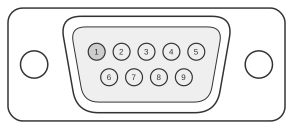 9 PIN D-SUB MALE at the monitor cable.
The IBM Monochrome Display Adapter (MDA), introduced with the original IBM PC in August 1981, uses a 9-pin DE-9 connector to carry TTL-level digital signals to a compatible monochrome monitor. The interface operates at a horizontal scan rate of 18.432 kHz and a vertical rate of 50 Hz, producing a 720×350 pixel resolution suitable for 80×25 text display. All signal lines operate at standard TTL voltages: 0.0–0.6 V (logic low) and +2.4–3.5 V (logic high). The Hercules Graphics Card uses the identical connector and pin assignments, adding a 720×348 bit-mapped graphics mode whilst remaining electrically compatible with MDA monochrome monitors.
| Pin | Name | Description |
|---|---|---|
| 1 | GND | Ground |
| 2 | GND | Ground |
| 3 | - | - |
| 4 | - | - |
| 5 | - | - |
| 6 | I | Intensity |
| 7 | VID | Video |
| 8 | HSYNC | Horizontal Sync TTL Positive |
| 9 | VSYNC | Vertical Sync TTL Negative |
Notes
The DE-9 socket is mounted on the card bracket (female); the monitor cable terminates in a DE-9 male plug. Pins 3–5 are not connected on standard MDA and Hercules cards; some early MDA boards were electrically capable of outputting R/G/B TTL signals on these pins, but this was not a supported configuration. Pin 9 carries an active-low (negative) vertical sync signal. The Hercules Graphics Card (model GB101) conforms to the same electrical specification and connector pinout as the IBM MDA.
Signals
- GND — Signal ground; pins 1 and 2 are both grounded on the IBM MDA connector.
- I — Intensity; a second TTL bit combined with the Video signal to produce four display states: off (0,0), dim (0,1, non-standard on many monitors), normal green (1,0), and bright green (1,1).
- VID — Monochrome video signal at TTL levels; drives the phosphor intensity of the display.
- HSYNC — Horizontal synchronisation pulse, TTL positive, at 18.432 kHz.
- VSYNC — Vertical synchronisation pulse, TTL negative (active low), at 50 Hz.