
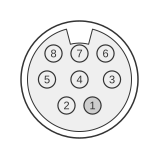
 8 PIN DIN FEMALE at the computer
| Pin | Name | Dir | Description |
|---|---|---|---|
| 1 | NSYNC | OUT | Sync? |
| 2 | GREEN | OUT | Green |
| 3 | LUM | OUT | Luminance |
| 4 | RED | OUT | Red |
| 5 | BLUE | OUT | Blue |
| 6 | AOL | OUT | Audio Output Left |
| 7 | AOR | OUT | Audio Output Right |
| 8 | GND | - | Ground |
The Amstrad CPC6128 Plus, released in 1990, uses an 8-pin circular DIN female socket (part reference CSK150-81-30-244) for its monitor output. This connector superseded the 6-pin DIN used on the original CPC6128, adding stereo left and right audio channels alongside the analogue RGB video, composite sync, and luminance signals. The compatible monitors listed by Amstrad are the CM-14 colour monitor and the MM-12 monochrome monitor. No industry-wide standard governed the pinout; Amstrad defined the assignments independently as part of the Arnold V ASIC specification.
Notes
- Direction is Computer relative to Monitor.
- The connector is a standard full-size 8-pin circular DIN socket, not a Mini-DIN. The two formats differ in shell diameter and key geometry and are not interchangeable.
- Part reference for the socket: CSK150-81-30-244.
- Red, Green, and Blue signals are analogue outputs.
- The stereo audio channels (pins 6 and 7) carry the same signals as the separate stereo audio connector on the CPC Plus models.
- The GX4000 game console uses the same 8-pin DIN socket with the same signals.
Signals
- NSYNC — Composite sync output (pin 1). The signal name “NSYNC” indicates a negative-polarity composite sync; the Amstrad CPC464 Plus Service Manual confirms this pin carries composite sync.
- GREEN — Analogue green video output.
- LUM — Luminance output, used by monochrome monitors such as the MM-12.
- RED — Analogue red video output.
- BLUE — Analogue blue video output.
- AOL — Analogue audio output, left channel.
- AOR — Analogue audio output, right channel.
- GND — Signal ground.