
 9 PIN D-SUB FEMALE at the videocard
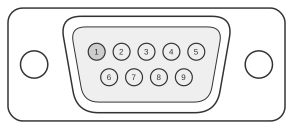 9 PIN D-SUB MALE at the monitor cable
The IBM Professional Graphics Controller (PGC) — commonly called the Professional Graphics Adapter (PGA) — was a high-end ISA video card released by IBM in August 1984. Unlike the contemporary MDA, CGA, and EGA adapters, which all output TTL digital signals, the PGC delivers analogue RGB video converted by an on-board 12-bit DAC (4 bits per colour channel), yielding 256 simultaneously displayable colours chosen from a palette of 4,096. The card uses the same DE-9 shell as other IBM PC display adapters of the era but carries analogue signals, making it electrically incompatible with TTL monitors. Its native resolution is 640×480 pixels; an emulator mode provides 640×400 CGA-compatible output. The governing technical reference is IBM document 6138161 (August 1984), published in IBM Technical Reference: Options and Adapters Volume 3.
| Pin | Name | Description |
|---|---|---|
| 1 | R | Red |
| 2 | G | Green |
| 3 | B | Blue |
| 4 | CSYNC | Composite Sync |
| 5 | MODE | Mode Control |
| 6 | RGND | Red Ground |
| 7 | GGND | Green Ground |
| 8 | BGND | Blue Ground |
| 9 | GND | Ground |
Signals
- R — Analogue red video output; DAC-converted from a 4-bit red channel in the 12-bit colour lookup table.
- G — Analogue green video output; DAC-converted from a 4-bit green channel.
- B — Analogue blue video output; DAC-converted from a 4-bit blue channel.
- CSYNC — Composite sync; carries both horizontal and vertical synchronisation on a single line.
- MODE — Mode control (pin 5); function is not definitively documented in the IBM manual. seasip.info notes it may be either not connected or a switch selecting between 400-line (emulator/CGA-compatible) and 480-line (native high-function) operation.
- RGND — Red signal return ground; a dedicated ground for the red analogue channel, separate from the common logic ground on pin 9.
- GGND — Green signal return ground; dedicated return for the green analogue channel.
- BGND — Blue signal return ground; dedicated return for the blue analogue channel.
- GND — Logic ground.
Notes
The PGC DE-9 connector uses the same IEC 60807-3 / DIN 41652 shell as MDA, CGA, and EGA adapters, but the signals are fundamentally different: pins 1–3 carry analogue voltages, not TTL logic levels. Connecting a PGC to a TTL monitor will not produce a usable image and may damage the monitor input stage. The separate per-channel return grounds (pins 6–8) are a characteristic feature of analogue RGB wiring; they reduce crosstalk between colour channels compared with a single common ground.
The card operates in two modes: high-function graphics mode at 640×480, and emulator mode at 640×400 which mimics IBM CGA output. The official IBM name for the card is Professional Graphics Controller (PGC); the designation Professional Graphics Adapter (PGA) is a widely used but informal term not found in IBM’s own marketing literature.
References
- IBM Technical Reference: Options and Adapters Volume 3 (document 6138161, August 1984) — IBM Corporation (via Bitsavers / Internet Archive); contains the PGC connector specification at page 180.
- Professional Graphics Controller Notes — seasip.info — John Elliott; independent technical reference documenting the DE-9 pinout and analogue signal characteristics.