
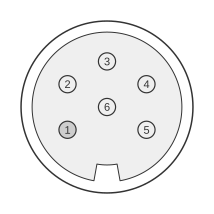
 6 PIN DIN (DIN45322) FEMALE at the computer
The Amstrad CPC6128, released in 1985, outputs video via a proprietary 6-pin DIN socket (DIN45322) on the rear of the machine, carrying analogue Red, Green, and Blue signals alongside composite sync and luminance. There is no governing industry standard for this connector; Amstrad defined the pinout independently to suit its own CTM644 colour monitor and GT65 green monochrome monitor. Unusually, the computer also supplies 12 V DC power to the monitor through a separate 5 mm coaxial plug rather than over the video connector itself.
| Pin | Name |
|---|---|
| 1 | RED |
| 2 | GREEN |
| 3 | BLUE |
| 4 | SYNC |
| 5 | GND |
| 6 | LUM |
Signals
- RED — analogue red video output.
- GREEN — analogue green video output.
- BLUE — analogue blue video output.
- SYNC — composite sync output (combined horizontal and vertical sync).
- GND — signal ground.
- LUM — luminance output, used by the GT65 green monochrome monitor to derive a brightness signal from the combined RGB content.
Notes
- The connector is a 6-pin circular DIN female socket (DIN45322) on the computer; the monitor cable terminates in the corresponding male plug.
- Compatible monitors are the CTM644 colour monitor and the GT65 green screen monitor, both supplied by Amstrad for the CPC6128.
- A separate 5 mm coaxial plug on the monitor cable carries 12 V DC from the computer to power the monitor’s electronics; this supply is distinct from the video signals on the DIN connector.
- The CPC6128 Plus (a later revision) uses a different, incompatible 8-pin DIN connector with a re-ordered pinout and added stereo audio channels.