
The Phase II Macintosh modem cable connects the mini-DIN-8 serial port introduced on the Macintosh Plus (1986) to a standard DB-25 male DCE modem jack. Both modem and printer ports on Macintosh Plus and later models are electrically identical RS-422 balanced-differential interfaces, controlled by the Zilog Z8530 Serial Communications Controller (SCC); in the unbalanced RS-232-compatible mode used for modem cables, only the negative (−) data lines are connected. Phase I and Phase II are two successive Apple-defined cable revisions that differ primarily in how the handshake lines HSKo and HSKi are wired to the modem’s control signals — Phase II routes RTS/CTS flow-control through HSKo and HSKi rather than the DTR-only arrangement of Phase I.
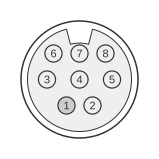 8 pin mini-DIN male connector
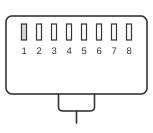 8 pin RJ45 (8P8C) male connector
Notes
- The mini-DIN-8 connector carries RS-422 balanced-differential signals; Pin 1 (HSKo) is wired to the Z8530 DTR output and Pin 2 (HSKi) serves as handshake input or external clock. Pin 7 (GPIn, general-purpose input) is absent on the Mac Plus but present on later models.
- In RS-232-compatible modem wiring, RxD+ (Pin 8) is tied to GND (Pin 4) to bias the differential receiver into single-ended mode; TxD+ (Pin 6) is left unconnected or tied to GND.
- The Phase II cable differs from the Phase I variant in its handshake wiring: Phase II uses HSKo and HSKi for RTS/CTS hardware flow control, enabling higher-throughput modem operation.
- Maximum sustained throughput on 68000-based Macs is approximately 19.2 kbps; 68020/030 machines support up to 57.6 kbps; 68040-class Macs and Quadras reach 115.2 kbps; GeoPort-equipped AV and Power Macs support up to 230.4 kbps.
- Both the modem port (telephone icon) and the printer port (printer icon) are electrically identical and may be used with a modem cable.
References
- Guide to the Macintosh Family Hardware, 2nd ed. (Apple/Addison-Wesley, 1990)
- Inside Macintosh: Devices — Serial Driver (Apple Computer, 1995)
- Apple Technical Procedures: Peripheral Interface Guide, PN 072-0213D (Apple Computer, 1989)
- TIA/EIA-422-B: Electrical Characteristics of Balanced Voltage Digital Interface Circuits (ITU-T V.11 equivalent)