
The Conrad Electronics MM3610D is a digital multimeter manufactured by Metex (Korea) and sold under the Conrad brand. This passive, 5-wire RS-232 cable connects the multimeter’s proprietary 5-pin Conrad special connector to a PC’s DB-25 serial port, enabling data logging at 600 or 1200 baud using the Metex 14-byte ASCII protocol (7 data bits, no parity, 2 stop bits). The cable contains no active components; the DTR line (DB-25 pin 20) must be asserted high and RTS (DB-25 pin 4) must be held low, as these control lines together supply power to the multimeter’s opto-isolated receiver circuit. This variant is functionally identical to the 9-pin version, differing only in the PC-end connector.
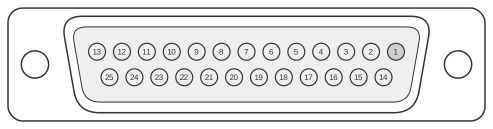 25 PIN D-SUB FEMALE to PC
5 PIN UNKNOWN CONNECTOR to the multimeter
| PC | Conrad | Dir | |
|---|---|---|---|
| Request To Send | 4 | 1 | OUT |
| Receive Data | 3 | 2 | IN |
| Transmit Data | 2 | 3 | OUT |
| Data Terminal Ready | 20 | 4 | OUT |
| Ground | 7 | 5 | - |
Signals
- RTS (Request To Send) — DB-25 pin 4; must be held LOW (de-asserted) to power the multimeter’s opto-isolated receiver circuit correctly.
- RxD (Receive Data) — DB-25 pin 3; carries serial data from the multimeter to the PC.
- TxD (Transmit Data) — DB-25 pin 2; carries the host query byte (typically 0x44 ‘D’) from the PC to the multimeter.
- DTR (Data Terminal Ready) — DB-25 pin 20; must be asserted HIGH to supply operating current to the multimeter’s receiver circuit via the opto-isolator.
- GND (Signal Ground) — DB-25 pin 7; common signal reference.
Notes
- The Conrad 5-pin connector exists in two physical versions: one with equal pin spacing (older, reversible) and one with a gap between pins 3 and 4 (keyed, fits one way only).
- The Conrad special connector pin numbering and signal order differ from the generic Metex 5-pin RS-232 cable used on models such as the Voltcraft M-3650CR; the two cables are not interchangeable.
- Serial protocol: 600 or 1200 baud, 7 data bits, no parity, 2 stop bits (7n2). On each query, the multimeter returns a 14-byte ASCII response: 2-byte mode, space, sign, 5-byte value with decimal point, 4-byte unit, and a carriage-return (0x0D).
- No active components are present in the cable. Incorrect DTR/RTS state will prevent the multimeter from transmitting.
References
- Metex M-3610D / M-3650D Digital Multimeter Manual — Metex Corporation