
The Kodak DC-family serial interface cable connects the camera’s 8-pin mini-DIN port to a PC’s DB-9 RS-232C serial port for image transfer. The family spans first-generation consumer digital cameras produced between approximately 1995 and 2000, covering the DC40, DC50, DC120, DC240, DC280, DC3400, and DC5000 models, as well as rebranded equivalents including the RCA CDS4100, Vivitar 3500, and Rollei D7COM. The DC120 specifies an RS-422/232 dual-mode interface rated at up to 230 Kbps, while the DC240, DC280, DC3400, and DC5000 share a common serial protocol operating at a default of 9600 baud (8-N-1) with true RS-232 voltage levels required. The cable was supplied with the camera; Kodak advised using only the provided cable.
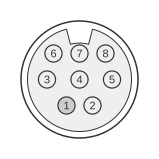 MINIDIN 8 PIN MALE - to the digital camera
 9 PIN D-SUB FEMALE - to the PC serial port
| Minidin 8 Pin | DB9 Pin |
|---|---|
| 1 | - |
| 2 | - |
| 3 | 1 |
| 4 | 3 |
| 5 | 2 |
| 6 | - |
| 7 | 4 |
| 8 | 1 |
Notes
- Pins 5, 6, 7, and 8 of the DB-9 are joined together; pin 9 is not connected.
- The DC240, DC280, DC3400, and DC5000 require DTR to be held high for at least 470 milliseconds before initiating communications.
- These cameras require true RS-232 voltage levels. A TTL-to-RS-232 level converter is necessary when interfacing with microcontrollers or other TTL-level devices.
- The DC120 supports both RS-422 (Macintosh modem/printer port) and RS-232C (PC serial port) connections via separate cables supplied with the camera.
- On older PCs equipped with a 25-pin serial port, a 9-to-25-pin adapter is required.