
The Commodore 64 User Port (a 24-pin DZM 12 DREH edge connector) implements serial communication at inverted TTL levels rather than true RS-232 voltages, with the transmit and receive signals having opposite polarity to standard RS-232. The Macintosh serial port, governed by TIA/EIA-422-B (ITU-T V.11), provides each data line as a balanced differential pair — a non-inverted (+) line and an inverted (−) line. Because the C64’s TTL signals are already logically inverted, connecting the non-inverted Mac RS-422 lines (TXD+ and RXD+) to the C64’s User Port restores correct polarity without requiring an active level converter. The Mac end of this cable uses a mini-DIN-8 connector, the standard on all Macintosh models from the Plus (1986) onwards; GND and RXD− are tied together to bias the differential receiver into single-ended mode.
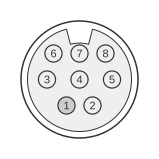 8 PIN MINI-DIN MALE to the Macintosh
DZM 12 DREH to the C64 UserPort
| Mac | C64 |
|---|---|
| GND+RXD- | 4+5 |
| RXD+ | 8 |
| TXD+ | 6 |
Notes
- The Macintosh mini-DIN-8 serial port implements RS-422 balanced differential signalling; for single-ended (RS-232-compatible) use, RXD− is tied to GND to bias the differential input, and only the non-inverted lines carry data.
- The C64 User Port delivers RS-232 serial at inverted TTL logic levels (not true ±12 V RS-232 voltages); no external level-converter chip is required for this cable because the polarity inversion is handled by selecting the Mac’s + lines.
- Maximum reliable baud rate via the C64’s KERNAL bit-banging routine is approximately 1200 baud; some software implementations can achieve 2400 baud but VIC-II DMA interference (“badlines”) limits stability.
- The C64 User Port connector is a 24-pin male edge connector (DZM 12 DREH format, 3.96 mm pitch, accepting 1.57 mm PCBs).
Signals
Mac side (mini-DIN-8)
- GND (pin 4) — Signal ground; tied together with RXD− to provide a common reference and to bias the differential RX input into single-ended mode.
- RXD− (pin 5) — Receive data, inverted (−) line; tied to GND in this cable to complete the differential biasing.
- RXD+ (pin 8) — Receive data, non-inverted (+) line; carries incoming data from the C64.
- TXD+ (pin 6) — Transmit data, non-inverted (+) line; carries outgoing data to the C64.
C64 side (User Port, DZM 12 DREH)
- GND (pins 4 + 5) — Signal ground; accepts the Mac GND+RXD− connection.
- RXD (pin 8) — Receive data input to the C64 (CIA 2 FLAG2 input, inverted TTL); driven by Mac TXD+.
- TXD (pin 6) — Transmit data output from the C64 (CIA 2 PB2/SP output, inverted TTL); drives Mac RXD+.