
The Apple QuickTake 100 (1994) and 150 (1995) use a mini-DIN 8 connector on the camera body — the same form factor as the Mac modem and printer ports — with the Windows cable wired mini-DIN 8 to DB-9 (RS-232C) and the Mac cable wired mini-DIN 8 to mini-DIN 8 (RS-422). The QuickTake 200 (1997) differs: its camera-side port is a 2.5 mm stereo miniplug labelled “Digital port”, with separate cables for Mac (to mini-DIN 8 modem/printer port) and PC (to DB-9). All models initialise communication at 9600 bps, 8N1, with speed negotiable to higher rates via the QuickTake software. A standard 9-to-25-pin serial adapter is required to connect the DB-9 cable to older PCs fitted with a 25-pin COM port.
Cable pinouts for the QuickTake 150, Windows connection kit from a DB9 to DB25 cable adapter
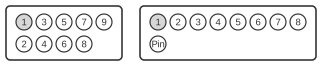
| DB9 (socket) | DB25 (plug) | Signal |
| 1 | 8 | DCD |
| 2 | 3 | RxD |
| 3 | 2 | TxD |
| 4 | 20 | DTR |
| 5 | 7 | SG |
| 6 | 6 | DSR |
| 7 | 4 | RTS |
| 8 | 5 | CTS |
| 9 | 22 | R1 |
| Shell | Shell | Shield |
Cable pinouts for the QuickTake for Windows from a Mac Din 8 to PC DB9 Serial cable
| Mac Din 8 | PC DB 9 |
| Pin | Signal |
| 1 | DTR |
| 2 | DSR |
| 3 | TxD- |
| 4 | SG |
| 5 | RxD- |
| 6 | TxD- |
| 7 | DCD |
| 8 | RxD+ |
| - | - |
Notes
- The QuickTake 100/150 Windows cable is mini-DIN 8 (camera) to DB-9 female (PC COM port). A 9-to-25-pin adapter is included in the Windows kit for older PCs with a 25-pin serial port.
- The Mac-side connector is mini-DIN 8, RS-422 balanced differential signalling. The RS-232C Windows cable uses only the minus (single-ended) lines: pin 3 (TxD−) carries transmitted data and pin 5 (RxD−) carries received data.
- DTR is used to wake the camera from sleep: the computer opens the port, asserts DTR high, then toggles it low. The camera responds with identification bytes once awake.
- Initial baud rate for the QuickTake 100/150 is 9600 bps, 8 data bits, 1 stop bit, no parity, no flow control. Speed may be negotiated up to 19200, 38400, or 57600 bps; even parity is enabled after speed negotiation.
- High-speed transfer at 38400 bps or above requires a buffered serial card with a 16550 UART on the PC side.
- The QuickTake 200 uses a different camera-side connector (2.5 mm stereo miniplug, labelled “Digital port”) and a BSC-variant protocol (DLE/STX framing, XOR checksum) with speeds negotiable up to 115200 bps via the CHANGE_SPEED command.
- Apple supplied proprietary cables in the respective “for Windows” and “for Macintosh” QuickTake boxes; the Windows and Mac cables are not interchangeable.
- Depending on the DB-9 port on the PC, the connector you use may be either a plug or socket DB-9.
Signals
- TxD− — Transmit data (minus/single-ended line); carries RS-232C data from PC to camera on the Windows cable
- RxD− — Receive data (minus/single-ended line); carries RS-232C data from camera to PC on the Windows cable
- TxD+ — Transmit data plus (RS-422 balanced pair); used on Mac RS-422 connection only
- RxD+ — Receive data plus (RS-422 balanced pair); used on Mac RS-422 connection only
- DTR — Data Terminal Ready; toggled low by the computer to wake the camera from sleep mode
- DSR — Data Set Ready; handshake line from camera to PC
- DCD — Data Carrier Detect; handshake line
- SG — Signal Ground