
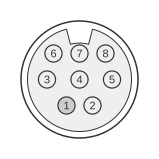
 8 Pin DIN Male Macintosh connector (to Macintosh computer)
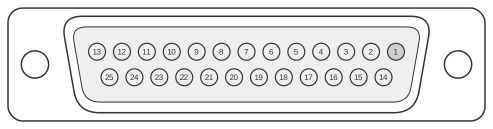 25 PIN D-SUB Female (to PC serial port)
 9 PIN D-SUB Female (to PC serial port)
Macintosh serial ports from the Plus onwards use an 8-pin mini-DIN connector driven by the Zilog Z8530 Serial Communications Controller, implementing RS-422 balanced differential signalling as defined by ANSI/TIA/EIA-422-B. For connection to RS-232 equipment such as a PC serial port, only the unbalanced (−) data lines are used: TxD− carries transmitted data and RxD− carries received data, while RxD+ is tied to signal ground to bias the differential receiver into RS-232-compatible mode. This null-modem cable crosses the transmit and receive pairs and maps the Macintosh handshake output (HSKo, wired to the Z8530 DTR pin) to the PC’s CTS, DSR, and DCD inputs, enabling flow control and connection detection on both DB-25 and DB-9 PC serial ports.
| Macintosh Signal Description | Mac DIN 8 Male | PC DB 25 Female | PC DB 9 Female |
|---|---|---|---|
| HSKo (Output Handshake) | 1 (OUT) | 5, 6, 8 (CTS, DSR, DCD) | 8, 6, 1 (CTS, DSR, DCD) |
| HSKi (Input Handshake) | 2 (IN) | 4 (RTS) | 7 (RTS) |
| TxD- (Transmit Data -) | 3 (OUT) | 3 (RxD) | 2 (RxD) |
| GND (Signal Ground) | 4 (GND) | 7 (GND) | 5 (GND) |
| RxD- (Receive Data -) | 5 (IN) | 2 (TxD) | 3 (TxD) |
| TxD+ (Transmit Data +) | 6 (OUT) | - | - |
| GPi (General Purpose Input) | 7 (IN) | 20 (DTR) | 4 (DTR) |
| RxD+ (Receive Data +) | 8 (IN, GND = RS232 Mode) | 7 (GND) | 5 (GND) |
Notes
- The Macintosh mini-DIN-8 connector is keyed and cannot be inserted incorrectly. Both the modem port (telephone icon) and printer port (printer icon) are electrically identical and may be used.
- TxD+ (pin 6) is left unconnected on the PC side; only the TxD− line is used for RS-232-compatible data transmission.
- RxD+ (pin 8) is tied to signal ground (pin 4/7 on the PC side) to hold the differential input in a defined state, enabling RS-232 single-ended reception on RxD−.
- HSKo (pin 1) is wired to the Z8530 DTR output; connecting it to CTS, DSR, and DCD simultaneously satisfies the PC’s handshake input requirements without requiring the Mac to assert separate control signals.
- HSKi (pin 2) receives RTS from the PC, allowing the PC to signal the Mac to pause transmission.
- GPIn (pin 7, labelled GPi here) functions as a general-purpose input equivalent to DCD; it is absent on the Mac Plus and earlier models.
- Maximum throughput depends on the Mac model: 68000-based Macs are limited to approximately 19.2 kbps; 68020/030 models support up to 57.6 kbps; 68040 and Quadra models up to 115.2 kbps.
- RS-422 electrical parameters: differential driver output ≥±2 V across 100 Ω load; receiver sensitivity ±200 mV; common-mode range −7 V to +7 V.
Signals
- HSKo — Handshake output from the Mac (Z8530 DTR); asserted by the Mac serial driver to signal readiness; wired to PC CTS, DSR, and DCD inputs in this null-modem configuration.
- HSKi — Handshake input to the Mac; receives RTS from the PC to implement hardware flow control or an external clock.
- TxD− — Transmit data, negative (unbalanced) line; carries serial data from Mac to PC in RS-232-compatible mode.
- GND — Signal ground reference shared between both ends.
- RxD− — Receive data, negative (unbalanced) line; carries serial data from PC to Mac.
- TxD+ — Transmit data, positive line of the RS-422 differential pair; left unconnected in RS-232-compatible wiring.
- GPi — General-purpose input (DCD equivalent); wired to PC DTR to detect modem/PC readiness; absent on Mac Plus and earlier.
- RxD+ — Receive data, positive line of the RS-422 differential pair; tied to signal ground to bias the differential receiver and enable single-ended RS-232 reception.