
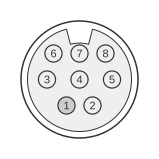
 8 pin mini-DIN male connector to the Macintosh
 24 pin DZM 12 DREH connector to the C64 UserPort
This null-modem cable connects the Macintosh mini-DIN-8 RS-422 serial port (introduced with the Macintosh Plus in 1986 and used through the beige-era Macs) directly to the Commodore 64 User Port, a 24-pin edge connector (DZM 12 DREH format, 3.96 mm pitch). The C64 implements RS-232 serial at inverted TTL signal levels rather than true RS-232 voltages, and without any on-board voltage conversion. Because the Mac’s RS-422 port provides both an inverted (−) and a non-inverted (+) line for each data direction, the cable uses the non-inverted TXD+ and RXD+ lines on the Mac side; this naturally restores the correct logic polarity when presented to the C64’s inverted-TTL inputs, eliminating the need for an active level converter. Maximum stable baud rate via the C64 KERNAL serial bit-banging routines is 1200 baud, though software can push to 2400 baud.
| Mac | C64 |
|---|---|
| GND+RXD- | 4+5 |
| RXD+ | 8 |
| TXD+ | 6 |
Notes
- The Macintosh mini-DIN-8 connector is keyed and cannot be inserted incorrectly; the modem port (telephone icon) and printer port (printer icon) are electrically identical and either may be used.
- RXD− (Mac pin 5) is tied together with GND (Mac pin 4) and connected to C64 User Port pins 4 and 5 (GND). This biases the Mac’s differential RS-422 RX input into single-ended mode, allowing the single-ended C64 TTL signal on RXD+ (Mac pin 8) to drive the receiver correctly.
- The C64 User Port carries TTL-level signals with inverted polarity (logic 0 = high voltage, logic 1 = low voltage), not true RS-232 voltage levels (±12 V). No MAX232 or equivalent driver is required for this cable.
- Maximum reliable throughput is constrained by the C64 KERNAL bit-banging routine to approximately 1200 baud due to VIC-II DMA “badlines” stealing CPU cycles; third-party software can reach 2400 baud.
- On the Mac side, throughput depends on the CPU: 68000-based Macs are limited to approximately 19.2 kbps; this cable’s practical limit is set by the C64 side.
Signals
Mac side (mini-DIN-8):
- GND — Signal ground (Mac pin 4)
- RXD− — Receive data, inverted/negative line (Mac pin 5); tied to GND in this cable to bias the differential input into single-ended mode
- RXD+ — Receive data, non-inverted line (Mac pin 8); carries data from C64 TXD (User Port pin 6)
- TXD+ — Transmit data, non-inverted line (Mac pin 6); carries data to C64 RXD (User Port pin 8)
C64 User Port (24-pin DZM 12 DREH edge connector):
- Pin 4, 5 — Ground; accepts GND+RXD− from Mac
- Pin 6 — RXD (CIA 2 FLAG2 input, inverted TTL); receives Mac TXD+
- Pin 8 — TXD (CIA 2 Port B PB2/SP output, inverted TTL); drives Mac RXD+