
The Phase I Macintosh modem cable connects the mini-DIN-8 serial port — introduced with the Macintosh Plus in 1986 and fitted to all subsequent beige-era Macs — to an external DCE modem. Both the modem port and the printer port are electrically identical RS-422 balanced differential interfaces controlled by the Zilog Z8530 Serial Communications Controller (SCC). For compatibility with RS-232 modems, only the unbalanced (−) data lines are used: TxD− carries transmitted data and RxD− receives it, while RxD+ is tied to GND to bias the differential input. The Phase I and Phase II cable designations describe two successive revisions of handshake wiring between the Mac’s HSKo/HSKi lines and the modem’s control signals; both variants terminate in a DB-25 male or RJ-45 (8P8C) male connector at the modem end.
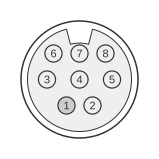 8 pin mini-DIN male connector
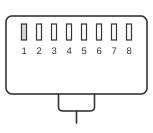 8 pin RJ45 (8P8C) male connector
Notes
- The mini-DIN-8 connector is a keyed 8-position circular DIN variant; correct orientation is ensured by the asymmetric key — the plug cannot be inserted upside-down.
- The Mac serial port operates in RS-422 balanced differential mode natively; RS-232-compatible devices require only the − signal lines (TxD−, RxD−) with RxD+ tied to GND.
- Maximum data rate on 68000-based Macs is approximately 19.2 kbps; 68020/030 machines support up to 57.6 kbps; 68040-based Quadras up to 115.2 kbps; GeoPort-equipped AV and Power Macs up to 230.4 kbps.
- HSKo (pin 1) is wired to the Z8530 DTR output and functions as the Mac’s primary handshake output to the modem. HSKi (pin 2) accepts handshake input or an external clock signal.
- The Phase I cable differs from Phase II in its specific routing of HSKo and HSKi to the modem’s RTS/CTS or DTR/DSR lines; consult Apple’s Serial Driver documentation for the exact handshake mapping of each revision.
- RS-422 electrical limits per TIA/EIA-422-B: differential driver output ≥ ±2 V across 100 Ω; receiver sensitivity ±200 mV; common-mode range −7 V to +7 V.
Signals
- HSKo — Handshake output; wired to Z8530 DTR; used as RTS or DTR toward the modem in RS-232 mode
- HSKi — Handshake input; accepts CTS/DSR from modem or an external serial clock
- TxD− — Transmitted data, negative (unbalanced) line; carries serial data from Mac to modem in RS-232-compatible mode
- TxD+ — Transmitted data, positive line; unused or tied to GND in RS-232-compatible wiring
- RxD− — Received data, negative (unbalanced) line; carries serial data from modem to Mac in RS-232-compatible mode
- RxD+ — Received data, positive line; tied to GND to bias the Z8530 differential input for RS-232 compatibility
- GPIn — General-purpose input; corresponds to the DCD (Data Carrier Detect) function; absent on Macintosh Plus and earlier models
- GND — Signal ground