
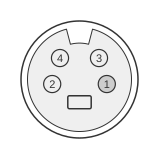
 4 pin mini-DIN female connector.
The Tandy MC-10 micro-computer, released in 1983, exposes a 4-pin DIN serial port that shares the same connector type and signal arrangement as the contemporaneous TRS-80 Colour Computer. The port provides true RS-232-C voltage levels (±12 V swing) via dedicated level-converter integrated circuits rather than relying on software bit-banging alone, though baud rate and framing are controlled purely by software delay loops. Only four signals are available — Carrier Detect, Receive Data, Ground, and Transmit Data — making the interface compact but limited compared with a full RS-232 port.
| Pin | Name | Description |
|---|---|---|
| 1 | CD | Carrier detect. |
| 2 | Rx | Receive data. |
| 3 | Ground | |
| 4 | Tx | Transmit data. |
Signals
- CD — Carrier Detect / general-purpose status input (Pin 1). Hardware-constrained as an input only; used to sense an active modem carrier or as a general logic-level status line.
- Rx — Receive Data input (Pin 2). Serial data from an external device into the MC-10; RS-232-C levels (positive voltage = logic 0, negative voltage = logic 1).
- Ground — Signal ground reference (Pin 3).
- Tx — Transmit Data output (Pin 4). Serial data from the MC-10 to an external device; always an output, RS-232-C levels.
Notes
- The connector is a 4-pin DIN (same type as used on the TRS-80 Colour Computer); the connector image label “mini-DIN-4” may be inaccurate — verify against the MC-10 Operation and Language Reference Manual.
- RS-232-C logic levels: high (logic 1) >+3 V; low (logic 0) <−3 V; the undefined zone is −3 V to +3 V.
- Default serial parameters (inherited from the Colour Computer ROM): 600 baud, 1 start bit, 7 data bits (LSB first), 2 stop bits, no parity. Later ROM revisions may use 8 data bits.
- Pin 1 (CD) and Pin 2 (Rx) are hardware-constrained as inputs; Pin 4 (Tx) is always an output. No hardware handshaking lines (RTS, CTS, DTR, DSR) are present.
- The governing serial standard for the signal definitions is EIA/TIA-232 (RS-232-C).
References
- TRS-80 Color Computer Technical Reference Manual (Cat. No. 26-3193) — Radio Shack / Tandy Corporation, 1981