
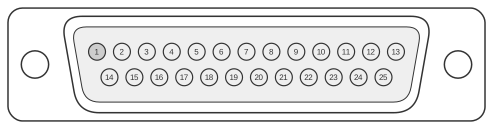
 25 PIN D-SUB MALE at the printer
The DB25 serial printer interface uses a 25-pin D-subminiature male connector on the computer (DTE) side, wired to a printer acting as DCE, in accordance with the EIA/TIA-232 standard (TIA-232-F, 1997) and its earlier EIA-232-D/E revisions. It was the original RS-232 connector form prescribed by the standard and remained in widespread use throughout the 1980s and 1990s for connecting dot-matrix, daisy-wheel, and other serial printers to personal computers and minicomputers. Signal levels follow EIA-232 conventions: driver outputs of ±5 V to ±15 V, with receiver thresholds at ±3 V, over cables of up to approximately 15 m.
| Pin | Name | Dir | Description |
|---|---|---|---|
| 1 | SHIELD | - | Shield Ground |
| 2 | TXD | OUT | Transmit Data |
| 3 | RXD | IN | Receive Data |
| 4 | n/c | - | Not connected |
| 5 | n/c | - | Not connected |
| 6 | DSR | IN | Data Set Ready |
| 7 | GND | - | System Ground |
| 8 | DCD | IN | Data Carrier Detect |
| 9 | n/c | - | Not connected |
| 10 | n/c | - | Not connected |
| 11 | ? | OUT | Reverse Channel |
| 12 | n/c | - | Not connected |
| 13 | n/c | - | Not connected |
| 14 | n/c | - | Not connected |
| 15 | n/c | - | Not connected |
| 16 | n/c | - | Not connected |
| 17 | TTY-TXD | OUT | TTY Receive Data |
| 18 | n/c | - | Not connected |
| 19 | n/c | - | Not connected |
| 20 | DTR | OUT | Data Terminal Ready |
| 21 | n/c | - | Not connected |
| 22 | n/c | - | Not connected |
| 23 | ? | OUT | TTY Receive Data Return |
| 24 | ? | IN | TTY Transmit Data Return |
| 25 | TTY-RXD | IN | TTY Receive Data |
Notes
The connector shown is the DB25 male (plug) on the computer or DTE side; the printer (DCE) end uses a DB25 female socket. Pin 1 (SHIELD) connects to the cable’s outer braid or foil shield and to the metal shell of the connector; it is distinct from pin 7 (signal ground) and should not be used as a signal return path.
Pins 4 and 5 (RTS/CTS) are listed as not connected in this implementation. Many serial printers rely on DTR/DSR flow control (pins 20 and 6) rather than RTS/CTS: the computer asserts DTR to signal readiness, and the printer responds with DSR; when the printer’s buffer is full it de-asserts DSR to pause transmission.
Pins 11, 17, 23, 24, and 25 carry TTY (current-loop) signals. The 20 mA current-loop interface was a secondary serial channel present on some older minicomputer-class printers and terminals, operating in parallel with the EIA-232 lines on the same DB25 shell. Pin 11 is a secondary reverse-channel output; pins 17 and 25 are the current-loop transmit and receive data lines; pins 23 and 24 are the corresponding signal-return (loop-current) paths.
Framing is asynchronous: 1 start bit, 7 or 8 data bits, optional parity, and 1 or 2 stop bits; typical baud rates were 300, 1200, 2400, 4800, or 9600 baud.
Signals
- SHIELD — Cable shield and connector-shell ground; connect to the braided/foil shield of the cable, not to pin 7.
- TXD — Transmit Data; serial data output from the computer to the printer.
- RXD — Receive Data; serial data input to the computer from the printer (used for status or bidirectional printers).
- DSR — Data Set Ready; asserted by the printer to indicate it is powered on and ready; used as the hardware flow-control input in DTR/DSR schemes.
- GND — Signal Ground; the common reference for all EIA-232 signal voltages.
- DCD — Data Carrier Detect; indicates a live connection; often held asserted (looped) on printer cables.
- DTR — Data Terminal Ready; asserted by the computer to indicate it is ready to communicate; the printer may de-assert DSR in response to pause output.
- TTY-TXD — Current-loop transmit data output from the computer (20 mA loop); secondary interface present on some older printers.
- TTY-RXD — Current-loop receive data input to the computer (20 mA loop); secondary interface.
- pin 11 (?) — Reverse Channel; function varies by implementation; associated with the secondary current-loop interface on some printer designs.
- pin 23 (?) — TTY Receive Data Return; current-loop return path for the receive data circuit.
- pin 24 (?) — TTY Transmit Data Return; current-loop return path for the transmit data circuit.
References
- TIA-232-F: Interface Between Data Terminal Equipment and Data Circuit-Terminating Equipment Employing Serial Binary Data Interchange — Telecommunications Industry Association, 1997 (supersedes EIA-232-D/E)
- Comtrol RocketPort EXPRESS User Manual — DB25 RS-232 pin assignments