
The Apple Macintosh DB-9 serial port is found on the original Macintosh 128K, 512K, and 512K Enhanced (Mac 512KE) — the only Macintosh models to use this connector. Apple used a 9-pin D-sub shell, female at the computer, to carry an EIA RS-422 balanced differential serial interface rather than the electrically simpler RS-232; differential signalling on the TxD+/TxD− and Rx+/Rx− pairs provides greater noise immunity and supports longer cable runs. The port also supplies +5 V and +12 V power rails to peripherals. From the Macintosh Plus (1986) onwards Apple replaced this connector with the 8-pin mini-DIN (mini-DIN-8), but an adapter cable (Apple part 590-0341 in beige, or 590-0553/699-0430 in smoke) bridges the DB-9 to the later mini-DIN-8 standard.
 9 PIN D-SUB MALE at the mouse cable.
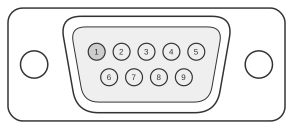 9 PIN D-SUB FEMALE at the computer.
| Pin | Name | Dir | Description |
|---|---|---|---|
| 1 | GND | - | Ground |
| 2 | +5V | OUT | +5 VDC. Don’t use this one, it may be converted into output handshake in later equipment. |
| 3 | GND | - | Ground |
| 4 | Tx+ | OUT | Transmit Data, positive going component |
| 5 | Tx- | OUT | Transmit Data, negative going component |
| 6 | +12V | OUT | +12 VDC |
| 7 | DSR/HSK | IN | Handshake input. Signal name depends on mode: Used for Flow Control or Clock In. |
| 8 | Rx+ | IN | Receive Data, positive going component |
| 9 | Rx- | IN | Receive Data, negative going component |
Signals
- GND — Signal ground; pins 1 and 3 are both ground returns.
- +5V — +5 V DC supply from the computer to the peripheral; Apple cautions against relying on this pin as it may be repurposed as an output handshake signal on subsequent equipment.
- Tx+ — Transmit Data positive leg; forms the differential pair with Tx−. RS-422 output from the computer.
- Tx- — Transmit Data negative (inverted) leg; differential complement to Tx+.
- +12V — +12 V DC supply rail, provided to power external serial devices.
- DSR/HSK — Handshake input; serves as Data Set Ready in modem-style use or as a clock/flow-control input depending on the operating mode.
- Rx+ — Receive Data positive leg; RS-422 differential input to the computer.
- Rx- — Receive Data negative (inverted) leg; differential complement to Rx+.
Notes
- Direction is Computer relative to Equipment.
- The connector at the computer is female DB-9; cables and peripherals use a male DB-9 plug.
- Signalling conforms to EIA RS-422 balanced differential, not RS-232; the TxD and RxD lines are each carried as a differential pair, giving noise immunity and support for cable runs beyond those achievable with RS-232.
- RS-232-C compatibility can be achieved by grounding the positive receiver side and leaving the transmitter positive side unconnected, creating an EIA RS-423 interface usable with RS-232-C devices over short distances.
- This DB-9 serial port is present only on the Macintosh 128K, 512K, and 512K Enhanced. The Macintosh Plus (1986) and all subsequent beige-era Macs use the 8-pin mini-DIN (mini-DIN-8) connector instead.
- Apple adapter cables (part numbers 590-0341 in beige, 590-0553, and 699-0430 in smoke) convert the DB-9 to mini-DIN-8 for use with later Mac peripherals.
References
- Apple Technical Procedures Peripheral Interface Guide (PN 072-0213D) — Apple Computer, Inc., March 1989