
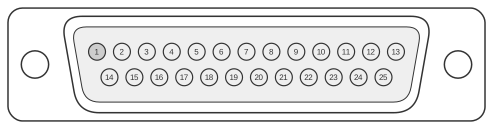
 25 pin D-SUB male connector.
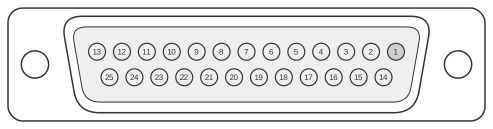 25 pin D-SUB female connector.
The Serial A port on the Apple Lisa and its rebranded successor the Macintosh XL uses a 25-pin D-sub (DB-25) male connector at the computer. It supports both RS-232-C and RS-422 operation at data rates from 300 to 57,600 bps. Unlike the simpler Serial B port, Serial A carries three synchronous clock signals — transmit clock input (TxC), receive clock input (RxC), and transmit clock output (TEXT) — enabling external clock synchronisation for synchronous serial protocols. Most of the DB-25 pins are not connected; only the pins documented in the Apple Technical Procedures Peripheral Interface Guide carry active signals.
| Pin | Name | Description |
|---|---|---|
| 1 | GND | Ground |
| 2 | TxD | Transmit Data line |
| 3 | RxD | Receive Data line |
| 4 | RTS | Request To Send |
| 5 | CTS | Clear To Send |
| 6 | DSR | Data Set Ready |
| 7 | GND | Ground |
| 8 | DCD | Data Carrier Detect |
| 9 | n/c | Not connected |
| 10 | n/c | Not connected |
| 11 | n/c | Not connected |
| 12 | n/c | Not connected |
| 13 | n/c | Not connected |
| 14 | n/c | Not connected |
| 15 | TxC | Connected to TRxCA |
| 16 | n/c | Not connected |
| 17 | RxC | Connected to RTxCA |
| 18 | n/c | Not connected |
| 19 | n/c | Not connected |
| 20 | n/c | Not connected |
| 21 | n/c | Not connected |
| 22 | n/c | Not connected |
| 23 | n/c | Not connected |
| 24 | TEXT | Connected to TRxCA |
| 25 | n/c | Not connected |
Signals
- GND — Signal ground; pins 1 and 7 both provide ground reference.
- TxD — Transmit Data; serial data output from the computer to the peripheral.
- RxD — Receive Data; serial data input from the peripheral to the computer.
- RTS — Request To Send; output asserted by the computer to indicate readiness to transmit.
- CTS — Clear To Send; input from the peripheral indicating it is ready to accept data.
- DSR — Data Set Ready; input from the peripheral indicating it is powered and ready.
- DCD — Data Carrier Detect; input asserted when the peripheral detects a carrier signal.
- TxC — Transmit Clock input; connected internally to the SCC TRxCA input, allowing an external device to supply the transmit bit clock for synchronous operation.
- RxC — Receive Clock input; connected internally to the SCC RTxCA input, allowing an external device to supply the receive bit clock.
- TEXT — Transmit Clock output (Transmit EXTernal); also connected to TRxCA, providing the internally generated transmit clock to an attached device for synchronous clock recovery.
Notes
- The connector at the computer is DB-25 male; a peripheral or modem cable presents DB-25 female.
- Serial A supports both asynchronous (RS-232-C compatible) and synchronous RS-422 operation; the three clock pins (15, 17, 24) are used only in synchronous mode.
- All pins not listed as active in the Apple Technical Procedures Peripheral Interface Guide are not connected inside the machine; do not assume any RS-232-C signal present on an unlisted pin.
- The Lisa/Macintosh XL was discontinued in 1985; this port is not present on any later Macintosh model, which uses the 9-pin DB-9 (Macintosh 128K/512K) or 8-pin mini-DIN (Macintosh Plus and later).