
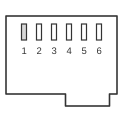
 6 pin MMJ female connector at the devices.
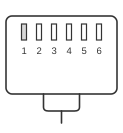 6 pin MMJ male connector at the cables.
The DEC Modified Modular Jack (MMJ), also referred to as the Corporate Modular Jack, is a 6-position, 6-contact (6P6C) connector with an offset latch tab that prevents accidental insertion of standard telephone plugs (RJ-11 or RJ-45). Introduced by Digital Equipment Corporation in the mid-1980s as part of the DECconnect wiring system, it carries signals conforming to DEC-423, DEC’s proprietary superset of EIA RS-423-A with tighter level tolerances and better noise filtering. The connector appeared across the full range of DEC asynchronous terminals — including the VT320, VT330, VT340, VT420, VT510, and VT525 — as well as VAX console ports and DECserver network terminal servers. DEC-423 signalling supports reliable operation over approximately 300 metres of unshielded cable and is compatible with EIA RS-232-C for data-only connections where modem-control lines are not required.
| Pin | Name | Description |
|---|---|---|
| 1 | DTR | Data Terminal Ready |
| 2 | TXD+ | Transmit Data + |
| 3 | TXD- | Transmit Data - |
| 4 | RXD- | Receive Data - |
| 5 | RXD+ | Receive Data + |
| 6 | DSR | Data Set Ready |
Signals
- DTR — Data Terminal Ready; driven by the terminal (DTE) to indicate it is powered and ready.
- TXD+ — Transmit Data positive signal; the active data line driven by the terminal.
- TXD- — Transmit signal ground (return); a separate isolated ground for the transmit pair, improving noise immunity. Not the chassis or power ground.
- RXD- — Receive signal ground (return); a separate isolated ground for the receive pair, driven by the host (DCE) side.
- RXD+ — Receive Data positive signal; the active data line driven by the host.
- DSR — Data Set Ready; driven by the host (modem or DCE) to indicate it is ready to communicate.
Notes
Connector mechanics. The MMJ is physically identical in housing size to a standard 6P6C modular plug, but the latch tab is offset to one side rather than centred. This keying prevents a telephone handset cord or RJ-11 patch cable from being inserted, protecting both the equipment and the wiring system.
Electrical standard. DEC-423 is a unbalanced (single-ended) signalling scheme, a superset of EIA RS-423-A with better filtering and tighter voltage tolerances. It is distinct from balanced RS-422 or RS-485. DEC-423 is electrically compatible with RS-232-C for data-only connections; the ± suffix on pin names (TXD+/TXD-, RXD+/RXD-) denotes signal and signal-ground pairs rather than a balanced differential pair in the RS-422 sense.
Separate signal grounds. Pins 3 (TXD-) and 4 (RXD-) are each dedicated signal-ground returns for their respective data lines, not a shared chassis ground. This arrangement improves noise immunity compared to single-wire RS-232 signalling. When adapting to RS-232, both pins 3 and 4 must be tied together and connected to the RS-232 signal-ground pin (pin 7 on a DB-25, pin 5 on a DE-9); omitting either one causes intermittent receive or transmit failures.
Null-modem (MMJ-to-MMJ) cables. The DEC BC16E MMJ-to-MMJ cable is wired as a crossover: pin 1 crosses to pin 6, pin 2 to pin 5, and pin 3 to pin 4. This allows two DTE devices (terminal and host) to communicate directly without a modem or null-modem adapter.
RS-232 adapters. The DEC H8571-A adapter converts MMJ (DEC-423) to a DB-25 RS-232 connector; the H8571-C converts MMJ to a DE-9 (DB-9) RS-232 connector. Use standard RS-232 pin assignments (TXD on pin 2, RXD on pin 3, GND on pin 7 for DB-25; TXD on pin 3, RXD on pin 2, GND on pin 5 for DE-9), with MMJ pins 3 and 4 both tied to the RS-232 ground pin.
Baud rates. The VT510, which uses this connector, supports baud rates up to 115.2 kbps with a 1024-byte receive buffer and asynchronous framing of start bit + 5–8 data bits + optional parity + 1–2 stop bits.