
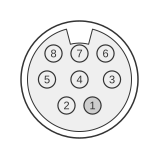
 Apple IIc Plus Printer/Modem port - 8 Pin MiniDIN female connector
The Apple IIc Plus (1988) replaced the original IIc’s 5-pin DIN serial connectors with mini-DIN-8 sockets, bringing the machine into line with the Apple IIgs and Macintosh Plus. Both the printer port and the modem port share this connector and use EIA RS-422 balanced differential signalling, giving noise immunity and compatibility with RS-232-C peripherals over short cable runs. The Apple IIc Plus Preliminary Reference explicitly states that the ports are “compatible with Apple IIGS serial interface cables”, confirming an identical pinout to those machines.
| Pin | Signal | Name | Notes |
|---|---|---|---|
| 1 | HSKo | Handshake Out | becomes active when the IIc is ready to go on line |
| 2 | HSKi | Handshake In | is asserted by the device the IIc is connected to when it is ready to go on line |
| 3 | TxD- | Transmit Data − | conveys serial data sent from the IIc (RS-422 inverted leg) |
| 4 | GND | Ground | |
| 5 | RxD- | Receive Data − | receives serial data sent from the device to the IIc (RS-422 inverted leg) |
| 6 | TxD+ | Transmit Data + | conveys serial data sent from the IIc (RS-422 non-inverted leg) |
| 7 | NC | Not Connected | |
| 8 | RxD+ | Receive Data + | receives serial data sent from the device to the IIc (RS-422 non-inverted leg) |
Signals
- HSKo — Handshake Out; driven by the IIc Plus to signal readiness; maps to the Zilog Z8530 SCC /DTR output; bipolar signal (Voh = +3.6 V, Vol = −3.6 V).
- HSKi — Handshake In; received by the IIc Plus from the peripheral; maps to the SCC /CTS and /TRxC inputs; threshold Vih = +0.2 V, Vil = −0.2 V.
- TxD− — Transmit Data, RS-422 inverted (negative) leg; paired with TxD+ to form the differential transmit pair.
- GND — Signal and chassis ground; reference for all signals.
- RxD− — Receive Data, RS-422 inverted (negative) leg; paired with RxD+ to form the differential receive pair.
- TxD+ — Transmit Data, RS-422 non-inverted (positive) leg.
- NC — Not connected; pin 7 is reserved and carries no signal on the IIc Plus.
- RxD+ — Receive Data, RS-422 non-inverted (positive) leg.
Notes
- The connector is an 8-pin mini-DIN (mini-DIN-8) female socket on the computer; peripheral cables use a male mini-DIN-8 plug. The port is physically identical to the IIgs and Macintosh Plus serial connectors.
- RS-232-C compatibility can be achieved by grounding the positive receiver legs (RxD+) and leaving the transmitter positive legs (TxD+) unconnected, creating an EIA RS-423 interface usable up to approximately 15 m (50 ft).
- Handshake signals are bipolar; a 0 V level is an indeterminate state and must not be used as a logic level.
- The maximum asynchronous data rate is 57,600 bps in X16 clock mode, governed by the shared 3.6864 MHz crystal oscillator on the serial subsystem.
- RS-422 differential signalling requires that each transmit/receive pair be treated as a balanced line; do not connect either leg to ground individually.
Modem Start-up Characteristics
- 300 baud
- 8 data bits
- No parity
- 1 stop bit
- No screen echo
- No Line Feed after Carriage Return (no LF after CR)
- No Carriage Returns in output stream
- Command Char= Control-A
Printer Start-up Characteristics
- 9600 baud
- 8 data bits
- No parity
- 2 stop bits
- 80-column line
- No screen echo
- Line Feed after Carriage Return
- Command Char= Control-I