
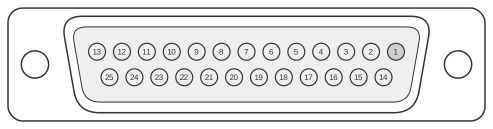
 25 PIN D-SUB FEMALE at the Amiga 1000.
The Amiga 1000 serial port is a 25-pin D-sub female connector (DB-25) implementing the RS-232-C standard in DTE orientation, driven by the Paula chip’s hardware UART. Introduced with the A1000 in 1985, the interface supports baud rates from 110 to approximately 250,000 bps; the rate is set via the SERPER register using the formula SERPER = (3,579,545 / baud) − 1 for NTSC systems. Whilst pins 1–8, 20 follow standard RS-232 assignments, many remaining pins carry Amiga-proprietary signals — including audio, clocks, power rails, and a buffered system reset — that differ in assignment between the A1000 and later models such as the A500, A2000, and A3000. The governing hardware specification is the Amiga Hardware Reference Manual (Commodore-Amiga Inc., 3rd edition, 1991), Appendix E.
| Pin | Name | Dir | Description |
|---|---|---|---|
| 1 | SHIELD | —— | Shield Ground |
| 2 | TXD | OUT | Transmit Data |
| 3 | RXD | IN | Receive Data |
| 4 | RTS | OUT | Request to Send |
| 5 | CTS | IN | Clear to Send |
| 6 | DSR | IN | Data Set Ready |
| 7 | GND | —— | System Ground |
| 8 | CD | IN | Carrier Detect |
| 9 | n/c | - | |
| 10 | n/c | - | |
| 11 | n/c | - | |
| 12 | n/c | - | |
| 13 | n/c | - | |
| 14 | -5V | OUT | -5 Volts DC (50mA max) |
| 15 | AUDO | OUT | Amiga Audio Out (Left) |
| 16 | AUDI | IN | Amiga Audio In (Right) |
| 17 | EB | - | EB=Buffered Port Clock 716 kHz |
| 18 | /INT2 | ? | Interrupt 2 |
| 19 | n/c | - | |
| 20 | DTR | OUT | Data Terminal Ready |
| 21 | +5V | OUT | +5 Volts DC |
| 22 | n/c | - | |
| 23 | +12V | OUT | +12 Volts DC (20 mA max) |
| 24 | /C2 | OUT | C2=Clock 3.58MHz |
| 25 | /RESET | OUT | Reset |
Notes
- Direction is DTE (Computer) relative DCE (Modem).
- Do not connect SHIELD (pin 1) to GND (pin 7); the shield is a frame ground and must remain isolated from signal ground.
- Warning: Pins 9–19, 21, 23–25 carry Amiga-proprietary signals or power rails, not RS-232 standard assignments. When making RS-232 cables, connect only those pins actually required for the application; connecting non-standard pins to external equipment may damage the Amiga or the peripheral.
- The A1000 pinout differs from later Amiga models (A500, A2000, A3000) on several non-RS-232 pins. In particular, later models carry +12 V on pin 9, −12 V on pin 10, audio out on pin 11, audio in on pin 18, and +5 V on pin 21 — assignments that do not all match the A1000 layout shown here.
- RS-232 output voltage levels: −13.2 V to −2.5 V (logic high / mark), +8.0 V to +13.2 V (logic low / space); maximum output current 10 mA. Input thresholds: +3.0 V to +25.0 V (positive), −25.0 V to −0.5 V (negative), with 1.0 V hysteresis.
- The Paula chip UART accepts any baud rate in the range 110–~250,000 bps (NTSC); the SERPER register value is calculated as SERPER = (3,579,545 / baud) − 1.
Signals
- SHIELD — Frame (chassis) ground; do not connect to signal GND (pin 7).
- TXD — Transmit Data; serial data output from the Amiga (DTE) to the modem or peripheral (DCE).
- RXD — Receive Data; serial data input to the Amiga from the DCE.
- RTS — Request to Send; handshaking output asserting the Amiga is ready to transmit.
- CTS — Clear to Send; handshaking input from DCE indicating it is ready to receive.
- DSR — Data Set Ready; input from DCE indicating the modem is powered and ready.
- GND — Signal ground reference for all RS-232 logic levels.
- CD — Carrier Detect; input from DCE indicating a carrier signal is present on the line.
- -5V — −5 V DC supply output (50 mA max); Amiga-proprietary, not an RS-232 signal.
- AUDO — Amiga audio output (left channel); Amiga-proprietary signal, not RS-232.
- AUDI — Amiga audio input; Amiga-proprietary signal, not RS-232.
- EB — Buffered port clock at 716 kHz (RXC on some documentation); Amiga-proprietary.
- /INT2 — Buffered interrupt line (direction uncertain in available sources); Amiga-proprietary signal.
- DTR — Data Terminal Ready; output from the Amiga asserting it is powered and ready.
- +5V — +5 V DC supply output; Amiga-proprietary power rail, not RS-232.
- +12V — +12 V DC supply output (20 mA max); Amiga-proprietary power rail, not RS-232.
- /C2 — Buffered 3.58 MHz clock output (TXC1 in some documentation); Amiga-proprietary.
- /RESET — Buffered system reset output (active low); Amiga-proprietary signal.
References
Aron P. Müller