
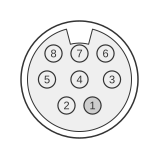
 8 PIN MINI-DIN FEMALE at the computer.
The Apple Macintosh RS-422 serial port uses EIA RS-422 balanced differential signalling, carrying transmit and receive data as differential pairs (TxD+/TxD− and RxD+/RxD−) to provide greater noise immunity and longer cable runs than RS-232. Introduced on the Macintosh Plus in 1986, the 8-pin mini-DIN connector replaced the earlier DB-9 used on the Macintosh 128K and 512K, and remained the standard serial interface through the beige Power Macintosh era. The hardware is driven by a Zilog Z8530 Serial Communications Controller (SCC); the maximum asynchronous data rate is 57,600 bps in X16 clock mode. Each Macintosh provided two such ports, commonly labelled Printer and Modem, both carrying the same pinout.
| Pin | Name | Dir | Description |
|---|---|---|---|
| 1 | HSKo | OUT | Output Handshake |
| 2 | HSKi/CLK | IN | Input Handshake or External Clock |
| 3 | TXD- | OUT | Transmit Data (-) |
| 4 | GND | - | Ground |
| 5 | RXD- | IN | Receive Data (-) |
| 6 | TXD+ | OUT | Transmit Data (+) |
| 7 | GPi | IN | General Purpose Input |
| 8 | RXD+ | IN | Receive Data (+) |
Notes
- Direction is DTE (Computer) relative DCE (Modem).
- GPi is connected to SCC Data Carrier Detect (or to Receive/Transmit Clock if the VIA1 SYNC signal is high). Not connected on the Macintosh Plus, Classic, Classic II, LC, LC II or IIsi.
- RS-422 output voltage levels: Voh = +3.6 V, Vol = −3.6 V (maximum load resistance 450 Ω); receiver thresholds: Vih = +0.2 V, Vil = −0.2 V (minimum input resistance 12 kΩ). Handshake signals are bipolar; a 0 V level is indeterminate.
- RS-232-C compatibility can be achieved by grounding the positive receiver side (RXD+) and leaving the transmitter positive side (TXD+) unconnected, producing an EIA RS-423 interface usable with RS-232-C devices up to approximately 15 m (50 ft).
- An adapter cable (Apple part 590-0341 in beige, or 590-0553/699-0430 in smoke) converts the earlier DB-9 (Macintosh 128K/512K) to mini-DIN-8.
- The governing standard is EIA RS-422-A (international equivalent ITU-T V.11 / X.27).
Signals
- HSKo — Handshake Output; maps to the SCC /DTR output; used for hardware flow control or as a general-purpose output.
- HSKi/CLK — Handshake Input or External Clock; maps to the SCC /CTS and /TRxC inputs; accepts an external transmit clock when synchronous operation is required.
- TXD− — Transmit Data, inverted (negative leg of differential pair).
- GND — Signal and chassis ground.
- RXD− — Receive Data, inverted (negative leg of differential pair).
- TXD+ — Transmit Data, non-inverted (positive leg of differential pair); leave unconnected when using RS-232-C adapter wiring.
- GPi — General-Purpose Input; maps to the SCC /DCD input; not connected on the Macintosh Plus, Classic, Classic II, LC, LC II, or IIsi; used in later models as an external clock input or general-purpose input.
- RXD+ — Receive Data, non-inverted (positive leg of differential pair); connect to signal ground when using RS-232-C adapter wiring.
References
- Apple IIgs Technical Note #30: Apple IIgs Hardware Reference Updates — Apple Computer, Inc.
- Apple Technical Procedures Peripheral Interface Guide (PN 072-0213D)
- Inside Macintosh: Devices — Serial Driver