Pinout of the 9-pin (DE-9 / DB-9) RS-232 PC serial port and its 10-pin motherboard header, with DTE/DCE signal directions.
Your support helps keep this website running. Please consider supporting this project. SPONSORDONATE
- Nicola Asuni
Updated:
9 pin DE9 male connector at the computer.
10 pin IDC male connector at motherboard.
RS-232 (standardised as EIA/TIA-232, today TIA-232-F) is the long-established asynchronous serial interface used by the PC “COM” port. On a PC the port is a 9-pin D-sub (DE-9, commonly called DB-9) wired as Data Terminal Equipment (DTE), connecting to Data Circuit-terminating Equipment (DCE) such as a modem. Besides transmit (TXD) and receive (RXD) data, it provides hardware handshaking lines (RTS/CTS, DTR/DSR) and status lines (DCD, RI). Signals are single-ended and bipolar — a logic 1 (mark) is a negative voltage and a logic 0 (space) a positive voltage, typically around ±5 to ±12 V — so they are not compatible with TTL levels without a converter. Internally the port is often brought out to a 10-pin IDC header.

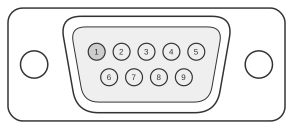 9 pin DE9 male connector at the computer.
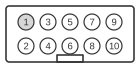 10 pin IDC male connector at motherboard.