
The auxiliary (AUX) port on Cisco 1000, 1600, 2500, 2600, and 3600 series routers is an RJ-45 (8P8C) connector configured as Data Terminal Equipment (DTE), implementing EIA/TIA-232 asynchronous serial signalling. Unlike the console port on the same routers, the AUX port uses all eight pins, including RTS and CTS, and therefore supports both hardware flow control and full modem control — making it suitable for connecting an external modem for out-of-band management. It is physically identical to the console port in connector type and uses the same flat rollover cable (pin 1 wired to pin 8, 2 to 7, 3 to 6, 4 to 5) together with an RJ-45-to-DB-9 or RJ-45-to-DB-25 adapter to reach a terminal or modem.
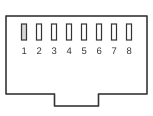 RJ45 FEMALE CONNECTOR at the Cisco routers)
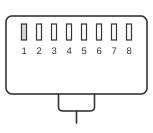 RJ45 MALE CONNECTOR at the cables
| Pin | Name | Description | Dir |
|---|---|---|---|
| 1 | RTS | Request To Send | OUT |
| 2 | DTR | Data Terminal Ready | OUT |
| 3 | TXD | Tranceive Data | OUT |
| 4 | GND | Ground | - |
| 5 | GND | Ground | - |
| 6 | RXD | Receive Data | IN |
| 7 | DSR | Data Set Ready | IN |
| 8 | CTS | Clear To Send | IN |
Signals
- RTS — Request To Send; asserted by the router to signal the attached modem or device that it is ready to transmit.
- DTR — Data Terminal Ready; driven by the router to indicate it is powered and operational.
- TXD — Transmitted Data; serial data output from the router to the attached device.
- GND — Signal ground reference; pins 4 and 5 are both ground (no data carried).
- RXD — Received Data; serial data input to the router from the attached device.
- DSR — Data Set Ready; input from the modem or device indicating it is ready.
- CTS — Clear To Send; input from the modem or device granting the router permission to transmit; used for hardware flow control.
Notes
- The AUX port connector is an RJ-45 (8P8C) jack on the router; the mating cable uses an RJ-45 plug at each end.
- A flat rollover cable is required: pin 1 connects to pin 8 at the far end, 2 to 7, 3 to 6, and 4 to 5. This is the same blue rollover cable (Cisco part CAB-500RJ=) used for the console port.
- An adapter is required to reach a PC or modem: the RJ-45-to-DB-9 adapter (grey, Cisco part CAB-500DTF= or equivalent) maps the rollover cable’s signals to a standard DB-9 DTE interface; an RJ-45-to-DB-25 adapter (grey) is also available.
- The AUX port supports hardware flow control via RTS/CTS and modem control via DTR/DSR — in contrast to the console port on these same routers, which uses neither.
- Default serial parameters are 9600 baud, 8 data bits, no parity, 1 stop bit; flow control is configurable.
- The port operates at EIA/TIA-232 signal levels (unbalanced), supporting speeds up to 64 kbps.