
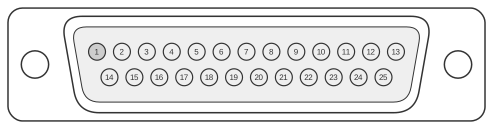
 25 pin D-SUB male connector at the computer.
The Apple line RS-232 serial interface uses a standard 25-pin D-sub (DB-25) male connector at the host end, implementing a subset of the EIA RS-232-C signalling standard for asynchronous serial communication. Only a handful of the 25 pins carry active signals; the remainder are left unconnected. The interface provides the core data, handshaking, and modem-control lines needed for printer, modem, and terminal connections, and is broadly compatible with RS-232-C DTE equipment of the same era.
| Pin | Name | Dir | Description |
|---|---|---|---|
| 1 | SNG | - | Shield ground |
| 2 | TXD | OUT | Tx Transmit Data, Out |
| 3 | RCD | IN | Rx Receive Data, In |
| 4 | RTS | OUT | Request to Send, Out |
| 5 | CTS | IN | Clear to Send, In |
| 6 | DSR | IN | Data Set Ready, In |
| 7 | GND | - | Ground |
| 8 | DCD | IN | Data Carrier Detect, In |
| 9 | n/c | No connection | |
| 10 | n/c | No connection | |
| 11 | n/c | No connection | |
| 12 | CH | IN | Data signal rate selector, In |
| 13 | n/c | No connection | |
| 14 | n/c | No connection | |
| 15 | n/c | No connection | |
| 16 | n/c | No connection | |
| 17 | n/c | No connection | |
| 18 | n/c | No connection | |
| 19 | n/c | No connection | |
| 20 | DTR | OUT | Terminal Ready Signal, Out |
| 21 | n/c | No connection | |
| 22 | CE | IN | Ring indicator, In |
| 23 | n/c | No connection | |
| 24 | n/c | No connection | |
| 25 | n/c | No connection |
Signals
- SNG — Shield/chassis ground; pin 1 per EIA RS-232-C frame ground convention.
- TXD — Transmit Data; serial data output from the DTE (computer) to the DCE (modem/printer).
- RCD — Receive Data; serial data input to the DTE from the DCE.
- RTS — Request to Send; asserted by the DTE to indicate it is ready to transmit.
- CTS — Clear to Send; asserted by the DCE to grant permission to transmit; used for hardware flow control.
- DSR — Data Set Ready; asserted by the DCE to indicate it is powered and ready.
- GND — Signal ground reference common to all data and control lines.
- DCD — Data Carrier Detect; asserted by the DCE when a carrier is detected on the telephone line or channel.
- CH — Secondary signal-rate selector (EIA RS-232-C circuit CH); input from the DCE indicating the selected data-signalling rate on a dual-rate modem.
- DTR — Data Terminal Ready; asserted by the DTE to signal that it is powered and ready for operation.
- CE — Ring Indicator (EIA circuit CE); asserted by the DCE to indicate an incoming ring signal on the telephone line.
Notes
- The connector at the computer is a 25-pin D-sub male (DB-25M); the cable or peripheral presents a female DB-25 plug.
- Only pins 1–8, 12, 20, and 22 carry active signals; all other pins are unconnected.
- Signalling is single-ended EIA RS-232-C; voltage levels are typically ±5 V to ±12 V. This interface is not RS-422 differential — do not confuse it with the RS-422-based mini-DIN-8 ports used on later Apple Macintosh and Apple IIgs computers.
- The Apple Technical Procedures Peripheral Interface Guide (PN 072-0213D, March 1989) covers the full range of Apple serial interfaces, including the RS-422 DB-25 ports of the Lisa/Macintosh XL and the mini-DIN-8 ports of later Macintosh and Apple IIgs models.