
OBD-II (On-Board Diagnostics, second generation) is the standardised emissions-diagnostics system fitted to cars worldwide. It defines a common 16-pin diagnostic connector — SAE J1962 — so that any compliant scan tool can read trouble codes and live data from the vehicle’s control units. The connector is protocol-agnostic: its terminals are assigned to whichever serial protocol a given vehicle uses. This page covers the K-line protocols ISO 9141-2 and ISO 14230-4 (Keyword Protocol 2000, KWP2000), and a simple interface that bridges the K-line to a PC RS-232 port.
ISO 9141-2 uses a single bidirectional wire (the K-line, pin 7) at about 10.4 kbit/s with a 5-baud “slow” initialisation; ISO 14230-4 (KWP2000) keeps the same K-line but adds a faster initialisation. The K-line idles at battery voltage (~12 V) and is not electrically compatible with RS-232, so a transceiver such as the NXP MC33290 or ST L9637 sits between the K-line and a microcontroller UART to bridge it to a PC serial port.
OBD-II became mandatory in the USA for 1996 model-year cars; in Europe, EOBD applied to new petrol cars from 2001 and diesels from 2004. From the 2008 model year, CAN (ISO 15765-4) replaced the K-line as the mandatory OBD-II data link on US vehicles.
This wiring scheme suits most European and Asian vehicles that use the ISO 9141-2 / KWP2000 K-line, including Alfa Romeo, Audi, BMW, Citroën, Fiat, Honda, Hyundai, Jaguar (X300, XK), Jeep (since 2004), Kia, Land Rover, Mazda, Mercedes, Mitsubishi, Nissan, Peugeot, Renault, Saab, Škoda, Subaru, Toyota, Vauxhall, Volkswagen (since 2001) and Volvo (to 2004).
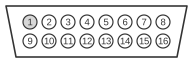 16 pin car OBD2 special connector at the vehicle
| Pin | Signal | Description |
|---|---|---|
| 1 | — | Manufacturer discretionary |
| 2 | J1850 Bus+ | SAE J1850 PWM/VPW (not used by ISO 9141 / 14230) |
| 3 | — | Manufacturer discretionary |
| 4 | Chassis ground | Vehicle chassis ground |
| 5 | Signal ground | Signal / logic ground |
| 6 | CAN High | ISO 15765-4 CAN (later vehicles) |
| 7 | K-line | ISO 9141-2 / ISO 14230-4 communication line |
| 8 | — | Manufacturer discretionary |
| 9 | — | Manufacturer discretionary |
| 10 | J1850 Bus− | SAE J1850 PWM (not used by ISO 9141 / 14230) |
| 11 | — | Manufacturer discretionary |
| 12 | — | Manufacturer discretionary |
| 13 | — | Manufacturer discretionary |
| 14 | CAN Low | ISO 15765-4 CAN (later vehicles) |
| 15 | L-line | ISO 9141-2 / KWP2000 optional secondary line |
| 16 | Battery +12 V | Unswitched vehicle battery positive |
The pins used by this page’s ISO 9141-2 / ISO 14230-4 interface are 4, 5, 7, 15 and 16.
Notes
- K-line vs L-line. Pin 7 (K-line) is the bidirectional serial line used by both ISO 9141-2 and ISO 14230-4 (KWP2000). Pin 15 (L-line) is an optional, mostly legacy line some early ISO 9141-2 systems used to initialise the ECU; many implementations omit it and use the K-line alone.
- Initialisation. ISO 9141-2 uses a 5-baud “slow” initialisation; ISO 14230-4 adds a “fast init” wake-up pulse. Both communicate at about 10.4 kbit/s.
- RS-232 interface. The K-line is a single-wire, open-collector bus idling at battery voltage, incompatible with PC RS-232 levels. An ISO K-line transceiver (NXP MC33290, ST L9637 or equivalent) translates between the battery-level K-line and a logic-level UART; a USB or serial adapter then carries the data to the PC.
- Power and grounds. Pin 16 supplies unswitched +12 V, so the interface is powered even with the ignition off. Pin 4 is chassis ground and pin 5 is signal ground, the reference for K-line signalling.
Signals
- K-line (pin 7) — bidirectional single-wire serial line for ISO 9141-2 and ISO 14230-4 (KWP2000); ~10.4 kbit/s, idles high at battery voltage.
- L-line (pin 15) — optional/legacy secondary line of ISO 9141-2, used by some systems for ECU initialisation.
- Battery +12 V (pin 16) — unswitched (permanent) battery positive, present regardless of ignition state.
- Chassis ground (pin 4) / Signal ground (pin 5) — power and signal returns; the K-line references signal ground.
References
- SAE J1962 — Diagnostic Connector (1995) — the standard defining the 16-pin connector and its terminal assignments.
- NXP MC33290 — ISO K Line Serial Link Interface datasheet — the transceiver that bridges the ISO 9141 / KWP2000 K-line to a microcontroller UART or serial port.