
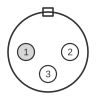
 3 pin XLR male connector.
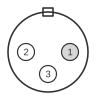 3 pin XLR female connector.
The 3-pin XLR is a circular multipole connector with a 19 mm nominal shell diameter, defined mechanically by IEC 61076-2-103:2004, and has been the universal connector for professional balanced analogue audio since the early 1980s. The pin assignment — Pin 1 shield/ground, Pin 2 signal+ (hot), Pin 3 signal− (cold) — is standardised by AES14-1992 (“pin 2 hot”) and harmonised as IEC 60268-12; AES48-2005 further requires Pin 1 to connect to the chassis rather than the audio circuit ground, suppressing the so-called “pin 1 problem”. The 3-pin XLR also appears on a range of stage and broadcast accessories including intercom partyline systems, haze machines, and proprietary lighting-control links, each with its own vendor-specific signal assignments. Note that use of 3-pin XLR for DMX512 lighting control is explicitly prohibited by ANSI E1.11-2008 (section 7.1.2), which mandates the 5-pin XLR; the 3-pin variant appears only on budget and DJ-market equipment that pre-dates or ignores the standard.
| Pin | ||
|---|---|---|
| Application | 1 | 2 |
| Clear Com | Ground (Shield) | Power (+20 to +30 VDC) |
| D54 | Screen | Noconnection |
| DMX512 (DMX) | Screen | Data - |
| TecProBackbone | Earth/Screen | Power+24VDC |
| Audio Signal (European) | Screen | Signal +(Hot) |
| JemTechnoHaze | Black | Yellow |
| Canford Talkback backbone | earth/screen | +24V DC |
| High End Systems intelligent fixtures control | ground | data - |
| Martin intelligent fixtures control (old) | screen | data + |
| Martin intelligent fixtures control (new) | screen | data - |
| Microphones (Europe standard) | screen | signal + |
| Microplex | common | +15 VDC |
| Balanced Audio | Ground / Screen | In phase / +ve / Hot |
| Unbalanced Audio | Ground / Screen | Signal |
Notes
- Pin 1 must connect to chassis ground (not audio signal ground) per AES48-2005 to avoid the “pin 1 problem” — a common source of hum and RF interference in professional installations.
- The “pin 2 hot” convention (AES14-1992 / IEC 60268-12) is now universal for professional audio; older European equipment sometimes used pin 3 as the hot conductor.
- Balanced audio transmits signal on a differential pair (Pins 2 and 3) relative to the shield (Pin 1); common-mode noise is rejected at the receiving end, making the 3-pin XLR suitable for long cable runs in electrically noisy environments.
- DMX512 use on 3-pin XLR is non-compliant with ANSI E1.11-2008, which explicitly prohibits it in section 7.1.2 and mandates the 5-pin XLR. Adapters between 3-pin and 5-pin DMX connectors are available but are considered a workaround rather than a standard practice.
- DMX512-A (ANSI E1.11) operates on EIA-485 differential signalling at 250 kbaud over 120 Ω shielded twisted pair; a 120 Ω termination resistor between Data+ and Data− is required at the far end of each run.
- The connector shell provides mechanical latching via a spring-loaded collar; do not force incompatible plug variants.