
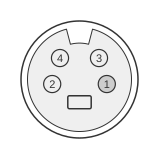
 4 PIN S-Video MINI-DIN Female
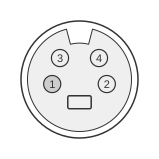 4 PIN S-Video MINI-DIN Male
S-Video (“Separate Video”, also called Y/C) is an analogue standard-definition video interface that carries the picture as two separate signals — luminance (Y, brightness plus sync) and chrominance (C, the modulated colour subcarrier) — rather than combining them into one composite wire. It appeared with S-VHS around 1987 and became common on consumer TVs, DVD players, S-VHS and Hi8 video recorders, camcorders, games consoles and the TV-out of graphics cards. The standard connector is a 4-pin mini-DIN; it carries video only (no audio) and standard-definition NTSC/PAL/SECAM only.
| Pin | Name | Description |
|---|---|---|
| 1 | GND | Ground (Y) |
| 2 | GND | Ground (C) |
| 3 | Y | Intensity (Luminance) |
| 4 | C | Colour (Chrominance) |
Notes
- Each of Y and C travels on its own 75 Ω signal-and-ground pair. Because luminance and chrominance arrive already separated, the display skips the imperfect Y/C separation (comb or notch filtering) that composite video requires; this avoids the cross-colour and cross-luminance artefacts (dot crawl) of composite and gives a sharper picture.
- The connector is a keyed 4-pin mini-DIN — align the key and do not force it. Signal levels into 75 Ω are about 1.0 V peak-to-peak for luminance (including sync) and about 0.3 V peak-to-peak for the chrominance burst.
- Luminance alone is effectively a monochrome composite signal, so a simple passive Y-to-composite adapter gives a black-and-white picture; correctly recombining Y and C into composite needs an active mixer and reintroduces the artefacts S-Video avoids.
- A 7-pin mini-DIN variant is sometimes used (with extra pins for composite passthrough on some PCs), but the inner four pins keep the same Y/C function.
Signals
- Y (luminance) — brightness and detail, including horizontal and vertical sync; ~1.0 V p-p into 75 Ω (pin 3).
- C (chrominance) — amplitude/phase-modulated colour subcarrier (3.58 MHz NTSC, 4.43 MHz PAL) with colour burst; ~0.3 V p-p into 75 Ω (pin 4).
- GND (Y) — luminance return/shield (pin 1).
- GND (C) — chrominance return/shield (pin 2).
References
- SMPTE ST 170-2004 — Composite Analog Video Signal (NTSC) — 75 Ω termination and the luminance/chrominance/burst signal levels.
- Texas Instruments TVP5150 NTSC/PAL Video Decoder datasheet — S-Video (Y/C) inputs and why Y/C separation is bypassed for S-Video.
- Renesas/Intersil AN9644 — Composite Video Separation Techniques — definition of the S-Video Y/C standard and the artefacts it avoids.