
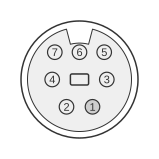
 7 pin mini-DIN female connector at the device.
The LifeView FlyDVB-T Duo and Hybrid CardBus are PC card tuners produced by Animation Technologies Inc. that receive DVB-T digital broadcasts and also accept analogue video via a proprietary 9-pin AV connector on the card edge. A breakout cable splits the 9-pin socket into a 4-pin mini-DIN S-Video input (Y/C), a composite video RCA socket, and left/right analogue audio RCA sockets, enabling connection of external sources such as VCRs or camcorders. The card supports analogue video decoding to NTSC, PAL, and SECAM standards as defined by ITU-R BT.470, and analogue audio standards including NICAM, A2, MTS/BTSC, and EIAJ.
| Pin | Name | Description |
|---|---|---|
| 1 | GND(Y) | Luminance Ground |
| 2 | GND(C) | Chrominance Ground |
| 3 | Y | Luminance - Intensity |
| 4 | C | Chrominance - Colour |
| 5 | R | Right Audio Channel |
| 6 | V | Composite Video |
| 7 | L | Left Audio Channel |
Signals
- GND(Y) — signal ground for the luminance (Y) channel of S-Video
- GND(C) — signal ground for the chrominance (C) channel of S-Video
- Y — luminance plus sync signal; 1 V peak-to-peak, 75 Ω; carries brightness information and composite sync pulses
- C — chrominance subcarrier; approximately 0.3 V peak-to-peak, 75 Ω; colour subcarrier at 3.58 MHz (NTSC) or 4.43 MHz (PAL)
- R — right analogue audio channel input from the breakout cable’s RCA red socket
- V — composite video (CVBS) input; 1 V peak-to-peak, 75 Ω, per ITU-R BT.1700
- L — left analogue audio channel input from the breakout cable’s RCA white socket
Notes
The pin table above reflects the S-Video subset (pins 1–4) which follows the standard 4-pin mini-DIN S-Video convention. Pins 5–7 are additional signals carried on the proprietary 9-pin housing. Animation Technologies never published an official pin-level diagram. The S-Video signals (pins 1–4) are consistent with the widely used EIAJ S-Video standard. Composite video (pin 6) should be terminated at 75 Ω.