
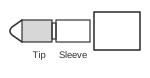
 6.25 mm MONO TELEPHONE MALE at the cable.
The 6.35 mm (¼ inch) mono phone plug is a 2-pole TS (Tip–Sleeve) cylindrical concentric connector whose contact names derive from 19th-century telephone switchboard terminology. Originating in switchboard installations of the 1870s, it became the first standardised audio connector and remains the dominant professional instrument connector for electric guitars, amplifiers, and balanced mono patch cables. The governing standards are IEC 60603-11:1992 and its US equivalent EIA RS-453; the Neutrik NP2X is a widely cited commercial implementation, rated for voltages below 50 V, an insulation resistance above 2 GΩ, and a mechanical lifetime exceeding 1,000 mating cycles.
| Name | Description |
|---|---|
| SIGNAL | Signal |
| GROUND | Ground |
Notes
- The correct nominal shaft diameter is 6.35 mm (exactly ¼ inch = 25.4 mm ÷ 4). The “6.25 mm” designation in the page title and image label does not correspond to any IEC/EIA standardised value or manufacturer specification; all products compliant with IEC 60603-11 / EIA RS-453 are dimensioned to 6.35 mm.
- The 2-pole TS configuration carries a single (mono) audio signal: Tip = Signal, Sleeve = Ground.
- Professional plugs (e.g. Neutrik NP2X) accept cable outer diameters of 4–7 mm and wire cross-sections up to 1 mm² (18 AWG). Operating temperature range is −20 °C to +65 °C.
- The dielectric strength is 1 kVdc; insulation resistance is ≥ 2 GΩ initial and ≥ 1 GΩ after damp-heat conditioning.
- Do not confuse the standard A-gauge 6.35 mm plug with the narrower-tipped B-gauge (bantam/TT) plugs used in broadcast patchbays; they share the same shaft diameter but have incompatible tip profiles.
Signals
- SIGNAL — mono audio signal carried on the Tip contact.
- GROUND — circuit ground (return) carried on the Sleeve contact.