
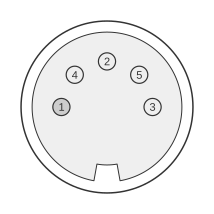
 5 PIN DIN FEMALE at the Computer.
The Texas Instruments TI-99/4A home computer, introduced in 1981, uses a 5-pin DIN female socket on its rear panel to carry both video and audio output to a monitor. The NTSC (US) and PAL (European) variants share the same physical connector but differ in their video signal arrangement: the PAL version outputs component Y, R-Y, and B-Y signals, while the NTSC version carries a single composite video signal. Video is generated by the TMS 9918 VDP and buffered to a 75-ohm output; audio is produced by the TMS 9919 (NTSC) or TMS 9929 (PAL) Sound Generator with up to 100 mW drive capability. Pin 1 supplies +12 V in both variants to power accessory circuitry.
| Pin | Name | Description |
|---|---|---|
| 1 | 12V vid | |
| 2 | R-Y | color burst clock |
| 3 | AUDIO | Sound output |
| 4 | Y | |
| 5 | B-Y | external video input? |
| U | GND | GROUND |
Notes
- Direction is Computer relative Monitor.
- The table above shows the PAL (European) variant. The NTSC (US) variant uses the same 5-pin DIN connector with a different pinout: pin 1 = +12 V, pin 2 = GND, pin 3 = Sound, pin 4 = Composite Video, pin 5 = Signal GND.
- Pin U denotes the connector shell/uninsulated contact used as chassis ground.
Signals
- 12V vid — +12 V supply on pin 1; powers the RF modulator or monitor circuitry in both NTSC and PAL versions.
- R-Y — Red minus luminance (chrominance difference) component; PAL variant only. Described in the TI service documentation as the colour burst clock.
- AUDIO — Mono sound output from the TMS 9919/9929 Sound Generator.
- Y — Luminance (brightness) signal; PAL variant. Carries the full composite video signal in the NTSC variant (where this pin is labelled Composite Video).
- B-Y — Blue minus luminance (chrominance difference) component; PAL variant. The label “external video input?” on this pin reflects uncertainty in older documentation; the TI technical data identifies it as B-Y.
- GND — Signal ground (shell/uninsulated contact U).