
The Commodore 1902A was a colour monitor produced by Commodore Business Machines in the mid-1980s, designed for use with the Commodore 64 and Commodore 128 computers. It accepted three distinct input types: a 6-pin DIN socket labelled “Separated LCA” for luma and chroma signals (40-column mode), an 8-pin DIN socket for TTL RGBI digital video from the C128’s 80-column output, and phono jacks for composite video and audio. The 6-pin DIN input shown here receives the separated luminance and chroma signals that originate from the 8-pin DIN A/V connector on the C64 or C128, carried via a breakout cable; composite and Separated LCA inputs cannot be used simultaneously.
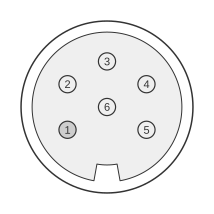 6 PIN DIN FEMALE at the Monitor
| Pin | Name | Dir | Description |
|---|---|---|---|
| 1 | n/c | - | Not connected |
| 2 | AUDIO | IN | Audio |
| 3 | GND | - | Ground |
| 4 | C | IN | Chroma |
| 5 | n/c | - | Not connected |
| 6 | L | IN | Luminance |
Notes
- Direction is Monitor relative Computer
- This 6-pin DIN socket is the monitor-side “Separated LCA” input; it is not a connector found on any Commodore computer — the computer carries an 8-pin DIN A/V output whose luma and chroma signals are routed to this plug via a dedicated cable.
- The 1902A’s separate 8-pin DIN socket accepts TTL RGBI from the C128’s 80-column output; that socket uses a completely different signal type and pinout.
- Composite video (phono jack, 1 Vp-p negative sync) and the Separated LCA input cannot be active at the same time.
- Audio input via pin 2 accepts up to 150 mV.
Signals
- n/c — Pins 1 and 5 are not connected.
- AUDIO — Analogue audio input from the connected computer; accepts up to 150 mV.
- GND — Signal ground.
- C — Chroma (colour subcarrier) input, corresponding to the chroma signal on pin 6 of the C64/C128 8-pin DIN A/V connector.
- L — Luminance/sync input, corresponding to the luma/sync signal on pin 1 of the C64/C128 8-pin DIN A/V connector.