
The Symbol LS2208 is a handheld laser barcode scanner that connects to a host PC via a keyboard wedge Y-cable (part number CBA-K01-S07PAR). The scanner end uses a 10-pin modular connector; the cable splits into a male 6-pin mini-DIN plug (to the host’s PS/2 keyboard port) and a female 6-pin mini-DIN socket (to the keyboard). The PS/2 keyboard interface, introduced by IBM with the Personal System/2 in 1987, uses a two-wire open-collector synchronous serial protocol over DATA and CLK lines at +5 V logic levels. The wedge arrangement allows the scanner to inject decoded barcode data as keystrokes into the keyboard stream without displacing the connected keyboard.
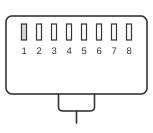 8 pin RJ45 (8P8C) male connector to the Scanner
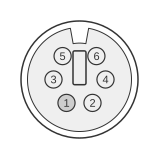 6 pin mini-DIN male (PS/2 STYLE) connector
| Scanner Name | Scanner Pin | Direction | Pin | Name | Description |
|---|---|---|---|---|---|
| Vcc | 1 | — | 4 | Vcc | Power +5 VDC |
| Gnd | 2 | — | 3 | Gnd | System ground |
| N/C | 3 | 2 | N/C | Not connected | |
| DATA | 4 | → | 1 | DATA | Data |
| N/C | 5 | 6 | N/C | Not connected | |
| CLK | 6 | ← | 5 | CLK | Clock |
Notes
- The original cable is a Y-type adapter that allows the scanner and keyboard to operate simultaneously from one PS/2 port.
- The scanner-side connector is a 10-pin modular plug; only six of its pins carry signals in the keyboard wedge configuration (pins 2, 3, 4, 5, 6, 7 per the LS2208 Product Reference Manual Table 3-3).
- Pin 4 on the scanner carries KeyClock; Pin 5 carries TermData (data from terminal/host to scanner); Pin 6 carries KeyData; Pin 7 carries TermClock.
- The PS/2 interface operates at +5 V; Pin 2 (scanner) supplies power and Pin 3 is ground across all supported interfaces.
Signals
- Vcc — +5 V power supply from the host PS/2 port to the scanner.
- Gnd — Signal and power return; common ground between scanner and host.
- DATA — Bidirectional serial data line (open-collector); scanner transmits decoded barcode keystrokes to host; host may send commands to scanner.
- CLK — Bidirectional clock line (open-collector); host holds CLK low to inhibit scanner transmission; scanner clocks each data bit on this line.