
 9 pin D-SUB female connector to the computer
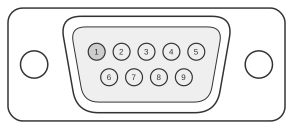 9 pin D-SUB male connector to the UPS
The APC 940-0095A is the proprietary PnP hybrid serial cable supplied with Back-UPS Pro models and certain third-generation Smart-UPS units. It carries both the simple (handshaking-line) signalling wiring and the RS-232 serial data lines of the smart 940-0024 cable within a single DB9-to-DB9 assembly, allowing software to auto-detect the appropriate communication mode. The UPS end presents a 9-pin D-SUB male connector; the computer end presents a 9-pin D-SUB female. APC’s Basic Port on the Back-UPS Pro supports remote on/off via pin 7 but does not supply the unregulated +24 Vdc found on Smart-UPS Advanced Port models.
| UPS end | Via | Computer end (DB9) | Function |
|---|---|---|---|
| Battery-Low (5) | two 47 kΩ resistors in series | DTR, DSR, CTS (4,6,8) | Low-battery sense |
| Shutdown (1) | 4.7 kΩ resistor | TxD (3) | |
| Shutdown (1) | 1N4148 diode | RTS (7) | Shutdown |
| Power-Fail (2) | direct | RxD, RI (2,9) | On Battery |
| Ground (4,9) | direct | GND (5) | Ground |
A 2N3906 PNP transistor (base fed from the Battery-Low resistor divider) pulls DCD (1) low through a 4.7 kΩ resistor to signal a low battery.
Signals
- BATTERY-LOW (UPS pin 5) — open-collector output from UPS; pulled low to signal a low-battery condition; drives the computer’s DCD line via a 2N3906 PNP transistor network
- SHUTDOWN (UPS pin 1) — shutdown input to the UPS; accepts a SPACE (positive RS-232 voltage) on RTS from the computer to initiate UPS shutdown; also biased via TxD through a resistor/diode network
- POWER-FAIL (UPS pin 2) — power-fail output from UPS; drives computer pins RxD and RI; a MARK (negative voltage) indicates mains power is present; transitions to SPACE when the UPS switches to battery
- GROUND (UPS pins 4, 9) — chassis and signal common; connected to computer pin 5 (SG) and the cable shell
- DTR (computer pin 4) — held at SPACE (positive voltage) by the computer; acts as cable power for the transistor circuit; also used as a loopback input alongside DSR/CTS to detect cable presence
- DSR / CTS (computer pins 6, 8) — loopback inputs; may be used by software to confirm the cable is connected
- DCD (computer pin 1) — low-battery indication to the computer; driven by the collector of the 2N3906; a SPACE on this line indicates the battery is low
- TxD (computer pin 3) — held at MARK (negative voltage) by the computer when idle; provides default bias to both the DCD and SHUTDOWN paths; if left open (e.g. computer off), a BATTERY-LOW event will automatically assert SHUTDOWN
- RTS (computer pin 7) — shutdown command from the computer; a SPACE on this line signals the UPS to shut down
- RxD / RI (computer pins 2, 9) — power-fail indication to the computer; a MARK indicates mains power is present; transitions to SPACE on battery
RS-232 convention: SPACE is a positive voltage (typically +12 V); MARK is a negative voltage (typically −12 V).
Notes
- The 940-0095A is a hybrid PnP cable: it includes both the discrete handshaking-line wiring (simple/dumb signalling) and the RS-232 serial data lines needed for smart-protocol communication. UPS management software uses jumpered pins on the cable to identify the cable type automatically.
- The UPS end is a 9-pin D-SUB male; the computer end is a 9-pin D-SUB female. All suffix variants of the 940-0095 part number (e.g. 940-0095A, 940-0095B) are electrically interchangeable; the suffix denotes only minor physical or OEM revisions.
- The Back-UPS Pro implements APC’s Basic Port, which supports the remote on/off feature (pin 7) but does not provide the unregulated +24 Vdc supply (pin 8) found on Smart-UPS Advanced Port models.
- The transistor bias network means that if the cable is connected to the UPS but the computer is off (TxD open-circuit), a BATTERY-LOW event from the UPS will automatically assert a SHUTDOWN signal — a behaviour to be aware of when the UPS is powered without a connected host.
- APC describes this interface as proprietary and intended solely for use with APC software, cables, and accessories.