
The Intel Express 100FX is a 100BASE-FX Fast Ethernet switch from the late 1990s that provides an EIA-232 console management port for out-of-band configuration. The console connection uses a null-modem cable between the switch’s console port and a workstation serial port, operating at 9600 baud, 8 data bits, no parity, and 1 stop bit. The computer-side connector is a 25-pin D-SUB female (DB-25). Intel never published a public pin-by-pin specification for this cable.
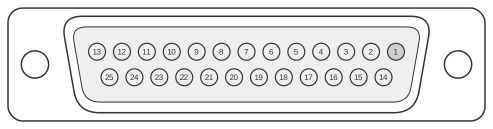 25 pin D-SUB female connector to the computer
| At Intel 100FX | At computer | Description |
|---|---|---|
| RTS | 1 | 5 |
| DTR | 2 | 8, 6 |
| TxD+ | 3 | 3 |
| TxGND | 4 | 7 |
| RxGND | 5 | 7 |
| RxD+ | 6 | 2 |
| DSR | 7 | 20 |
| CTS | 8 | 4 |
Signals
- RTS — Request To Send; flow-control output from the switch console port
- DTR — Data Terminal Ready; control output from the switch console port
- TxD+ — Transmit Data; serial data output from the switch
- TxGND — Transmit signal ground reference
- RxGND — Receive signal ground reference
- RxD+ — Receive Data; serial data input to the switch
- DSR — Data Set Ready; control input to the switch console port
- CTS — Clear To Send; flow-control input to the switch console port
Notes
- Console session parameters: 9600 baud, 8 data bits, no parity, 1 stop bit (8N1); VT100 or ASCII terminal emulation.
- The cable is a null-modem type; TxD and RxD are crossed between the two ends.
- EIA-232 (TIA/EIA-232-F) signal levels apply: mark = negative voltage below −3 V; space = positive above +3 V; maximum recommended cable length approximately 15 m at these baud rates.
- The DB-25 connector shown is the computer (DTE) end; the switch-side connector type is not publicly documented.
References
- Interface Circuits for TIA/EIA-232-F (SLLA037A) — Texas Instruments, September 2002