
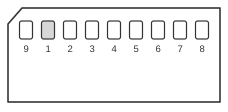
 9 pin Secure Digital Card
The Secure Digital (SD) card is a flash-memory card standard developed by the SD Association (founded by SanDisk, Panasonic and Toshiba) and introduced in 1999. It builds on the earlier MultiMediaCard (MMC), keeping a compatible interface while adding a content-protection mechanism (CPRM, aligned with the SDMI — Secure Digital Music Initiative). A card can be accessed either in its native SD bus mode (1- or 4-bit) or in the simpler SPI mode used by many microcontrollers. Later families increased capacity — SDHC (up to 32 GB) and SDXC (up to 2 TB) — and the smaller miniSD and microSD form factors use the same protocol with rearranged pins.
| Pin | SD mode | SPI mode | Description |
|---|---|---|---|
| 1 | CD/DAT3 (I/O/PP) | CS (I) | Card detect / data line 3 (SD); chip select, active low (SPI) |
| 2 | CMD (PP) | DI (I) | Command / response (SD); data in, host → card (SPI) |
| 3 | VSS1 (S) | VSS (S) | Ground |
| 4 | VDD (S) | VDD (S) | Supply voltage |
| 5 | CLK (I) | SCLK (I) | Clock |
| 6 | VSS2 (S) | VSS2 (S) | Ground |
| 7 | DAT0 (I/O/PP) | DO (O) | Data line 0 (SD); data out, card → host (SPI) |
| 8 | DAT1 (I/O/PP) | RSV | Data line 1 (SD); reserved (SPI) |
| 9 | DAT2 (I/O/PP) | RSV | Data line 2 (SD); reserved (SPI) |
Signal types: S = power supply, I = input, O = output, I/O = bidirectional, PP = push-pull, RSV = reserved.