
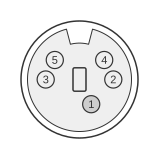
 5 pin mini-din connector at the device.
The Tandy MC-10 cassette port is a 5-pin DIN socket that provides the computer’s sole mass-storage interface, connecting to a standard consumer audio cassette recorder. It uses the same FSK encoding scheme as the Tandy TRS-80 Colour Computer (CoCo), with 1200 Hz representing a binary ‘0’ and 2400 Hz a binary ‘1’, yielding approximately 1500 baud. The interface carries audio data output to the recorder’s microphone input, audio data input from the recorder’s earphone output, and a motor remote control line to start and stop tape transport under software control. A standard cassette deck with adequate frequency response (300 Hz–3 kHz) and a remote motor socket is all that is required.
| Pin | Name | Description |
|---|---|---|
| 1 | Remote Ground | Recorder’s Ground. |
| 2 | Ground | Signal ground. |
| 3 | Control | Turns recorder on or off. |
| 4 | In | Audio data to MC-10. |
| 5 | Out | Audio data to recorder. |
Signals
- Remote Ground — Ground return for the motor remote control circuit (pin 3).
- Ground — Signal ground reference shared by audio data lines.
- Control — Motor remote control output; switches the cassette recorder’s motor on or off under software control to keep tape movement synchronised with data transfer.
- In — Audio data input to the MC-10 from the recorder’s earphone (EAR) jack; carries the FSK-encoded playback signal.
- Out — Audio data output from the MC-10 to the recorder’s microphone (MIC) input; carries the FSK-encoded write signal at approximately 1 V p-p.
Notes
- The connector is a 5-pin DIN socket on the MC-10 mainboard; the mating plug is a standard 5-pin DIN.
- Signal encoding is FSK (Frequency Shift Keying): 1200 Hz = ‘0’, 2400 Hz = ‘1’, at approximately 1500 baud — the same scheme used by the Tandy TRS-80 Colour Computer (CoCo 1/2/3).
- The motor control circuit (pins 1 and 3) actuates the remote socket on compatible cassette decks, stopping the tape when the computer is not actively reading or writing.
- No special cassette hardware is required; any standard audio cassette recorder with MIC input, EAR output, and a remote motor control jack is compatible, provided adequate frequency response (approximately 300 Hz–3 kHz).
References
- TRS-80 Color Computer Technical Reference Manual — Radio Shack / Tandy Corporation, 1981 (Cat. 26-3193); documents the 5-pin DIN cassette interface, FSK encoding, and ~1500-baud specification shared with the MC-10.