
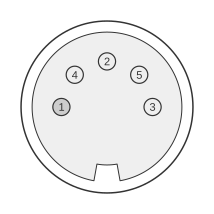
 5 PIN DIN 180° (DIN41524) FEMALE at the computer.
The Amstrad CPC6128 provides an external cassette interface via a 5-pin DIN socket, used to connect a standard audio cassette recorder for program and data storage. The interface carries audio-frequency FSK (Frequency Shift Keying) data signals and a motor remote-control line, allowing software to start and stop the tape transport automatically. Write speed is software-selectable at 1K or 2K baud; read speed is detected automatically by the firmware. The same connector and electrical specification was used on the earlier CPC464 and CPC664 models.
| Pin | Name |
|---|---|
| 1 | REMOTE SWITCH |
| 2 | GND |
| 3 | REMOTE SWITCH |
| 4 | DATA IN |
| 5 | DATA OUT |
Signals
- REMOTE SWITCH (pins 1 and 3) — Motor remote-control lines; connecting these two pins (via the cassette recorder’s remote socket) closes the relay circuit that controls the tape motor, allowing software to start and stop the recorder automatically.
- GND — Signal ground reference for all cassette signals.
- DATA IN — Audio input to the computer from the cassette recorder’s EAR (playback) output; carries the FSK-encoded bitstream read from tape.
- DATA OUT — Audio output from the computer to the cassette recorder’s MIC (record) input; carries the FSK-encoded bitstream written to tape.
Notes
- The connector is a 5-pin DIN 180° socket (DIN 41524) on the rear of the computer; Amstrad designated the connecting lead as CL1.
- Pins 1 and 3 together form the remote motor-control circuit: they are bridged by the cassette recorder’s remote relay to enable motor control under software command.
- Write speed is software-selectable: 1K baud or 2K baud. Read speed is established automatically by the firmware during the header phase.
- The CPC464 uses an identical cassette connector and circuit (part number 170025 for the DIN socket); alignment specifications call for 330 mV to 520 mV measured at IC302 pin 7.
- A standard audio cassette recorder with a MIC input, EAR output, and remote motor-control jack is sufficient; no specialist hardware is required.
References
- Amstrad CPC6128 Service Manual — Amstrad Consumer Electronics, 1985
- Amstrad CPC464 Service Manual — Amstrad Consumer Electronics, 1985