
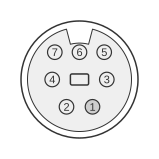
 7 pin mini-DIN female (key in the center) connector at the device.
The Commodore 1531 Datasette is the cassette tape storage unit designed exclusively for the Commodore C16, C116, and Plus/4 family of home computers, introduced in the mid-1980s. It connects via a 7-pin mini-DIN socket on the computer, which is mechanically and electrically incompatible with the 6-pin PCB edge connector used by the earlier C2N/1530 Datasettes designed for the VIC-20 and C64. The signal functions are functionally equivalent across both connector types — carrying ground, +5 V, motor control, read data, write data, and a sense line — with the 1531 adding a second dedicated ground pin (pin 7). Like its predecessors, the 1531 stores data using audio-frequency FSK encoding on standard cassette tape, with the computer’s software controlling tape motor operation via the Motor line.
| Pin | Name | Description |
|---|---|---|
| 1 | GND | Ground |
| 2 | Vcc | +5V |
| 3 | Motor | +5V |
| 4 | Read | |
| 5 | Write | |
| 6 | Sense | |
| 7 | GND | Ground |
Signals
- GND (pins 1 and 7) — Signal and chassis ground; the 1531 carries two dedicated ground pins, distinguishing it from the single-ground 6-pin edge connector used on VIC-20/C64 Datasettes.
- Vcc — +5 V supply from the computer to power the Datasette’s logic circuitry.
- Motor — Motor remote control line; the computer switches cassette deck motor operation on and off under software control, keeping tape movement synchronised with actual data transfer.
- Read — Serial data input to the computer from the Datasette’s playback head; carries the audio FSK signal decoded by the computer’s cassette interface circuitry.
- Write — Serial data output from the computer to the Datasette’s record input; carries the FSK-modulated audio signal representing the data to be recorded.
- Sense — Detects when the play button on the Datasette is depressed, allowing the computer to respond to user-initiated tape operations.
Notes
- The 7-pin mini-DIN connector is not interchangeable with the 6-pin PCB edge connector of the C2N/1530 Datasette; attempting to use a 1530-series Datasette with the Plus/4 or C16 requires an adapter.
- The mini-DIN shell carries a centre key, as depicted in the connector diagram; the plug must be oriented correctly before insertion.
- The C16, C116, and Plus/4 share this same cassette port design; all three accept the 1531 Datasette without modification.
- Data encoding is audio FSK at cassette signal levels, compatible with the same cassette interface approach used across the Commodore 8-bit range.
References
- Commodore C2N/1530/1531 Datasette Service Manual Preliminary (PN-314002-002) — Commodore Business Machines, October 1984
- Programmer’s Reference Guide for the Commodore Plus/4 — Commodore / Merten, Cyndie, 1984