
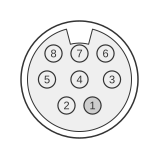
 8 pin mini-DIN female connector at the motherboard.
El Pina and M-Compa are OEM brand names for the Hsin Tech TX PRO-II mainboard, also sold as the PC Chips M571. This Baby AT, Socket 7 board used a SiS 5598 chipset and targeted Pentium/MMX-era systems around 1997–1998. The 8-pin header at board position PS2 exposes the PS/2 mouse interface; only four of its eight positions carry electrical signals (clock, data, +5 V, and ground), with the remaining four explicitly designated as no-connect in the manufacturer’s documentation. The PS/2 mouse protocol uses open-collector clock and data lines operating at approximately 10–16.7 kHz with TTL logic levels and a +5 V supply.
| Pin | Name | Description |
|---|---|---|
| 1 | clk | mouse clock |
| 2 | Vss | electrical ground |
| 3 | nc | no connection |
| 4 | data | mouse data |
| 5 | nc | no connection |
| 6 | nc | no connection |
| 7 | nc | no connection |
| 8 | Vcc | +5vdc |
Signals
- clk — bidirectional PS/2 clock line, open-collector, generated by the mouse device at 10–16.7 kHz; host latches data on the falling edge
- data — bidirectional serial PS/2 data line, open-collector; frames comprise 1 start bit, 8 data bits LSB-first, 1 odd-parity bit, and 1 stop bit
- Vcc — +5 V supply to the mouse device
- Vss — signal and power return (ground)
- nc (pins 3, 5, 6, 7) — no connection; these positions are explicitly unused in the manufacturer’s documentation
Notes
- The board carries the keyboard interface on a separate 5-pin female DIN (AT-style) connector at position KBD; it is not PS/2.
- An alternative route to the same PS/2 mouse signals is available on some board variants via the J7 ATX Form Card Connector (18-pin): pins 5/6/15/16 carry +5 V, mouse clock, mouse data, and ground respectively.
- IRQ12 is assigned to the PS/2 mouse in the board’s BIOS.
- The physical connector housing type (mini-DIN-8) is as labelled on this page; the manufacturer’s manual documents only the pin signals, not the housing specification.