
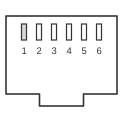
 6 pin RJ12 (6P6C) female connector at the computer.
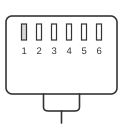 6 pin RJ12 (6P6C) male connector at the keyboard cable.
The Atari MEGA STE and TT030 keyboards communicate with the main system through a 6-pin RJ12 (6P6C) telephone-style jack over a bidirectional serial link running at exactly 7812.5 baud (8-bit word, 1 stop bit, no parity), clocked from a 500 kHz source divided by 64 and routed through a Motorola MC6850 ACIA. All keyboard, mouse, and joystick functions are managed inside the keyboard unit itself by an HD6301V1 8-bit microcomputer — the Intelligent Keyboard (IKBD) subsystem — which handles key scanning, quadrature mouse decoding, joystick switch reading, and a real-time clock. This architecture, introduced with the original Atari ST in 1985, was carried forward unchanged on the MEGA STE (1991) and extended as a compatible superset on the TT030 (1990).
| Pin | Description |
|---|---|
| 1 | +5V DC |
| 2 | +5V DC |
| 3 | Transmit Data |
| 4 | Receive Data |
| 5 | Ground |
| 6 | Ground |
Signals
- +5V DC — 5 V power supply to the keyboard unit; provided on both pins 1 and 2.
- Transmit Data — serial data sent from the keyboard (IKBD) to the main system; carries encoded key scan codes, mouse motion packets, joystick state, and real-time clock data.
- Receive Data — serial data from the main system to the IKBD; carries mode-configuration and command packets.
- Ground — common signal and power return; provided on both pins 5 and 6.
Notes
The connector is a standard 6-position 6-conductor (6P6C) modular jack, commonly called RJ12, mounted on the keyboard unit itself. The serial link operates at 7812.5 baud — not 7800 or 9600 — derived by dividing a 500 kHz clock by 64. The IKBD HD6301V1 firmware (4 KB ROM, 128 bytes RAM) processes all input locally; the main CPU receives only pre-encoded event packets. The TT030 keyboard interface is a compatible superset of the MEGA STE design, adding support for a 3-button mouse whilst retaining identical connector pinout and baud rate.