
LOOKING AT THE PLUG
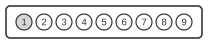
Sony Playstation 9pin connector
The PlayStation controller port is a proprietary 9-contact connector introduced with the original PlayStation (PS1) in 1994 and retained, with identical pin assignments, on the PlayStation 2 (2000). The bus uses a synchronous serial (SPI-like) protocol. Sony never published a standalone public specification for this connector or its protocol; documentation exists only in confidential developer SDK materials. Two controller ports are present on every PlayStation mainframe, and the port is also expandable via the Multi Tap adapter (SCPH-1070), which provides four controller and four memory-card connections per port.
| Pin | Signal | Signal name |
|---|---|---|
| 1 | DATA | Data |
| 2 | CMD | Command |
| 3 | +7.5V (motor) | Motor supply |
| 4 | GND | Ground |
| 5 | +3.5V logic | Logic supply |
| 6 | ATT | ATT select |
| 7 | CLK | Clock |
| 8 | N/C | Not connected |
| 9 | ACK | Acknowledge |
Signals
- DATA — Serial data from controller to console; 8-bit, LSB-first, open-collector (active low). Data is changed on the falling SCK edge and sampled on the rising edge.
- CMD — Serial command from console to controller; the counterpart to DATA, transmitted simultaneously on the same clock edges.
- +7.5V — Motor/rumble power supply derived from the console’s 7.5V DC input rail; present only on controller port (not memory card slot). The PSone SCPH-100 service manual labels this rail MOT7.5V/CTR7.5V.
- GND — Ground return.
- +3.5V — Logic supply for controller circuitry; nominally labelled +3.5V in PSY-Q SDK documentation. The PSone SCPH-100 service manual identifies the controller logic regulator output (IC606/IC607) as CTR3.3V (~3.3V actual).
- ATT — Active-low chip select (attention); pulled low by the console for the entire duration of a transmission. This is the only signal unique per port; it distinguishes controllers (address 0x01) from memory cards (address 0x81). Also referred to as /SEL or /CS in some documentation.
- SCK — Clock output from console to controller; approximately 250 kHz; CPOL=1, CPHA=1.
- /IRQ — Lightgun interrupt line; used only by the light gun peripheral to signal a screen-hit event. Not connected on standard controllers.
- ACK — Active-low acknowledge from controller to console; open-collector. Must be pulled low for at least 2 µs within 100 µs of the last SCK pulse after each byte, while ATT remains asserted. The console kernel treats a missing ACK as absence of a controller. No ACK is required after the final byte of a packet.
The controller port and memory card slot share the same serial bus (DATA, CMD, SCK, ACK); only the ATT line is unique per peripheral. DATA and ACK are open-collector to prevent bus contention when multiple devices are attached.
References
- PlayStation Controllers — PlayStation Developer Seminar, Fall 1996 (Sony CONFIDENTIAL)
- PlayStation Hardware — Developer Reference Series, August 1998 (PSY-Q SDK)
- PlayStation Developer’s Guide, Version 2.9 — Sony Computer Entertainment Europe, 1997 (CONFIDENTIAL)
- PSone SCPH-100 Series Service Manual, 2nd Edition — Sony Computer Entertainment Inc., Customer Service Department