
The Atari Computer System Interface (ACSI) is a proprietary 19-pin peripheral bus introduced with the Atari ST in 1985 and retained across the full Atari ST product family, including the Mega, STE, Mega STE, and TT030. It was used to connect external mass-storage devices, laser printers, and CD-ROM drives. ACSI employs ANSI X3T9.2-style command blocks similar to SCSI, but differs in that the host always controls the bus and there is no SCSI Message Phase. All signals operate at TTL levels, with the active-low control lines _IRQ and _DRQ held high by 1 kΩ pull-up resistors on the host side; the interface supports up to eight device IDs and a maximum sustained transfer rate of 1.25 MB/s.
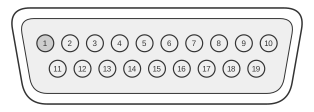 19 pin D-SUB male connector at the ATARI computer.
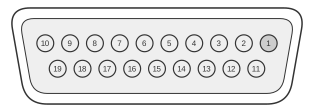 19 pin D-SUB female connector at the cable.
| Pin | Name | Description |
|---|---|---|
| 1 | D0 | Data 0 |
| 2 | D1 | Data 1 |
| 3 | D2 | Data 2 |
| 4 | D3 | Data 3 |
| 5 | D4 | Data 4 |
| 6 | D5 | Data 5 |
| 7 | D6 | Data 6 |
| 8 | D7 | Data 7 |
| 9 | /CS | Chip Select |
| 10 | IRQ | Interrupt Request |
| 11 | GND | Ground |
| 12 | /RST | Reset |
| 13 | GND | Ground |
| 14 | ACK | Acknowledge |
| 15 | GND | Ground |
| 16 | A1 | ? |
| 17 | GND | Ground |
| 18 | R/W | Read/Write |
| 19 | /DRQ | Data Request |
Signals
- D0–D7 — 8-bit bidirectional data bus; TTL levels.
- /CS — Chip Select; driven by the host to address the peripheral (active low).
- IRQ — Interrupt Request; asserted by the peripheral to signal the host (active low, 1 kΩ pull-up on host side).
- /RST — Reset; highest-priority control signal; resets all connected devices.
- ACK — Acknowledge; driven by the host during DMA hardware-handshake transfers to accept each byte.
- A1 — Address line 1; driven by the host.
- R/W — Read/Write; driven by the host to indicate transfer direction.
- /DRQ — Data Request; asserted by the peripheral to request a DMA byte transfer (active low, 1 kΩ pull-up on host side).
Notes
- The DB-19 shell is a custom D-subminiature size not used in PC industry standards; the computer-side socket is a DB 19S (female), and the cable plug is a DB 19P (male).
- Two transfer modes are supported: software handshake (command and status phases) and DMA hardware handshake using /DRQ and ACK.
- Maximum total daisy-chain cable length is 72 inches (approximately 1.83 m); Atari documentation recommends no more than four ACSI controllers for reliable operation, though the protocol supports up to eight device IDs (0–7).
- Pin 16 (A1) function is not documented in detail in publicly available sources beyond its role as an address line.
References
- ATARI ACSI/DMA Integration Guide (June 28, 1991) — Atari Corporation
- Engineering Hardware Specifications of the Atari ST Computer System — Toolkit B1-50 (January 7, 1986) — Atari Corporation
- Atari TT 030 Hardware Reference Manual — Toolkit B1-90a (June 1990) — Atari Corporation