
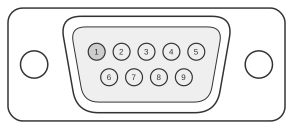
 9 PIN D-SUB MALE to the mouse
 6 PIN MINI-DIN MALE to the computer
A serial-to-PS/2 mouse adapter is a purely passive wiring cable — it contains no active circuitry — that connects the DE-9 RS-232 serial plug of a mouse to the 6-pin mini-DIN PS/2 socket of a host computer. The PS/2 mouse interface was introduced by IBM with the Personal System/2 family in 1987 and uses a bidirectional synchronous serial protocol at TTL levels (0 V/+5 V) over an open-collector bus running at 10–16.7 kHz. The RS-232 serial mouse protocol operates at 1200 baud using a 3-byte Microsoft-compatible packet format, drawing power from the RTS line via an on-board voltage-conversion circuit. Because the adapter itself performs no protocol conversion, it functions only with a combo mouse — a device that detects which interface is present at power-on and switches its internal protocol accordingly.
| Mini-DIN | D-SUB |
|---|---|
| +5V | 4 |
| Data | 1 |
| Gnd | 3 |
| Clock | 5 |
Signals
- +5V — supply voltage to the mouse from the PS/2 port; sourced from pin 4 of the 6-pin mini-DIN
- Data — bidirectional serial data line (PS/2 side); open-collector, TTL levels; maps to DE-9 pin 1 (DCD/Data Carrier Detect line used as mouse data output on serial mice)
- Gnd — signal ground common to both interfaces
- Clock — PS/2 clock line; open-collector, 10–16.7 kHz; no direct equivalent on the RS-232 side — present only on the PS/2 connector
Notes
- This is a passive adapter; no protocol conversion takes place. It operates only with combo mice that auto-detect their active interface at power-on.
- The RS-232 serial mouse uses only three DE-9 signals in normal operation: RxD (pin 2), RTS (pin 7), and Signal Ground (pin 5); power is derived from the RTS line internally.
- The PS/2 side carries +5 V on pin 4 and uses open-collector clock and data lines; both sides must share a common ground.
- The 6-pin mini-DIN PS/2 connector pins 2 and 6 are not connected.