
This passive adapter connects a keyboard fitted with the 6-pin mini-DIN connector — introduced with the IBM Personal System/2 range in 1987 — to a computer equipped with the 5-pin DIN 180° (DIN41524) socket first defined for the IBM Personal Computer AT (Model 5170) in 1984. Both connectors carry the same four active signals: Keyboard Clock, Keyboard Data, Ground, and +5 Vdc; the mini-DIN connector adds two reserved pins (2 and 6) and renumbers the active contacts. Because the underlying serial protocol is electrically identical across both interfaces, the adapter requires no active components — it is a straight pin-to-pin rewire.
 5 PIN DIN 180° (DIN41524) MALE to the computer.
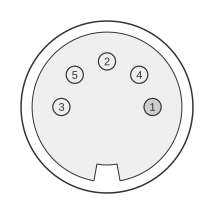 6 PIN MINI-DIN FEMALE (PS/2 STYLE) to the keyboard.
| Mini-DIN | DIN | |
|---|---|---|
| Shield | Shield | Shield |
| Data | 1 | 2 |
| Ground | 3 | 4 |
| +5 VDC | 4 | 5 |
| Clock | 5 | 1 |
Signals
- Data — bidirectional serial keyboard data; open-collector line pulled to +5 Vdc.
- Ground — signal and power return.
- +5 VDC — keyboard power supply from the host; open-collector lines pulled high through this supply.
- Clock — bidirectional serial clock; open-collector line; keyboard generates clock during transmission, host may inhibit by holding clock low.
Notes
The adapter is entirely passive. Both interfaces use the same bidirectional serial protocol: 11-bit frames consisting of a start bit, eight data bits, odd parity, and a stop bit. Signal lines are open-collector and TTL-compatible, with a low-level output maximum of 0.5 V and a high level pulled to approximately +5 Vdc. The AT 5-pin DIN pin 3 is designated Spare by IBM and carries no signal in this adapter; it was not carried forward from the earlier IBM PC XT, where the equivalent pin carried an active-low keyboard reset signal.
References
- IBM PC AT Technical Reference (5170), Document 1502494, March 1984
- IBM PC AT Technical Reference (5170), Document 6139362, September 1985
- IBM Personal System/2 Hardware Interface Technical Reference, May 1988
- IBM PS/2 Hardware Interface Technical Reference — Common Interfaces, Document 84F9735, October 1990