
camera connector or camera cable scheme used for computerized long exposure control
 9 pin D-SUB female connector at the PC
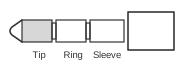 3 pin stereo plug connector at the DSLR camera (2.5 mm for Canon 300D, 1/8 for Canon 10D)
The Canon EOS 300D (Digital Rebel / Kiss Digital, 2003) carries no native RS-232 port; its wired remote input is the E3 terminal, a 2.5 mm sub-mini three-conductor (TRS) jack also used by the EOS D60, 10D, and 1D (via a 2.5 mm-to-N3 adaptor). The DIY shooter-control cable routes the PC serial port’s DTR line (DB9 pin 4) through a transistor or MOSFET to actuate the E3 jack: tip drives focus, ring drives shutter release, and sleeve is ground. This is not a data-serial link; only the switched DTR output and signal ground from the DB9 connector are used. The original Canon RS-60E3 remote switch operates on the same terminal with a two-stage button — first stage activates autofocus, second stage releases the shutter.
Notes
The E3 terminal operates at approximately 3.3 V with around 0.5 mA. The cable is compatible with Canon EOS cameras fitted with the E3 terminal; the EOS 1D requires a separate 2.5 mm-to-N3 mechanical adaptor but uses the same electrical interface. Only DB9 pins 4 (DTR) and 5 (GND) are connected; all other serial lines are left open.