
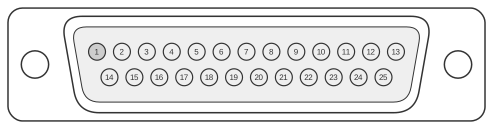
 25 PIN D-SUB MALE to Computer 1
25 PIN D-SUB MALE to Computer 2.
ParNet is a null-network cable created by Doug Walker, John Toebes, and Matthew Dillon of The Software Distillery, first distributed in 1993 via a package assembled by Vernon Graner of Commodore Business Machines. It links two Amiga computers through their 25-pin D-sub parallel ports, exposing a NET: file-system device under AmigaDOS 1.3 and 2.0 at roughly 20–40 KB/s. The cable uses a straight-through DB-25 to DB-25 wiring with pins 10 and 13 bridged at both ends; pins 1, 14–17, and 23–25 are left unconnected. The eight data lines (pins 2–9) are driven by CIA-A Port B ($BFE001) on each Amiga.
| Name | Pin | Pin | Name |
|---|---|---|---|
| Data Bit 0 | 2 | 2 | Data Bit 0 |
| Data Bit 1 | 3 | 3 | Data Bit 1 |
| Data Bit 2 | 4 | 4 | Data Bit 2 |
| Data Bit 3 | 5 | 5 | Data Bit 3 |
| Data Bit 4 | 6 | 6 | Data Bit 4 |
| Data Bit 5 | 7 | 7 | Data Bit 5 |
| Data Bit 6 | 8 | 8 | Data Bit 6 |
| Data Bit 7 | 9 | 9 | Data Bit 7 |
| Acknowledge + Select | 10+13 | 10+13 | Acknowledge + Select |
| Busy | 11 | 11 | Busy |
| Paper Out | 12 | 12 | Paper Out |
| Signal Ground | 17-25 | 17-25 | Signal Ground |
Notes
- The cable is straight-through (pin N to pin N on both sides) with two bridging links: pin 10 (/ACK*) is shorted to pin 13 (SEL) at each end.
- Pins 1, 14–17, and 23–25 must be left unconnected; on the A1000 pin 23 carries +5V, whereas on the A500/A2000/A3000 pin 23 is GND — connecting these between machines risks damage.
- The Amiga A1000 has a male DB-25P parallel connector; the A500, A2000, and A3000 have a female DB-25S connector. An adapter is required to connect an A1000 to any later model.
- Maximum recommended cable length is 5–10 metres; the parallel port is not designed for longer runs.
Signals
- Data Bit 0–7 (pins 2–9) — Eight bidirectional data lines driven by CIA-A Port B (address $BFE001) on each Amiga; wired straight-through between the two machines.
- Acknowledge + Select (pins 10+13) — Pin 10 (/ACK*, handshake input) and pin 13 (SEL, status input) are bridged together at both ends; this allows each machine to signal the other using the /ACK* line and read back the state via SEL.
- Busy (pin 11) — Status input line used for flow control signalling between the two machines.
- Paper Out (pin 12) — Status input line used as an additional signalling channel.
- Signal Ground (pins 17–25) — Ground reference for the data and control lines.
References
- ParBENCH 3.1 — Aminet comm/net package (includes ParNet ReadMe and Cable.DOC)
- Amiga Hardware Reference Manual, 3rd Edition — Commodore-Amiga Inc., 1991 (Appendix E, p. 317; Appendix F, p. 339)