
A 25-pin DB-25 serial loopback plug (also called a wrap plug) is a diagnostic connector used to test RS-232 serial ports by shorting the transmit outputs back to the corresponding receive inputs, allowing diagnostic software to verify UART hardware without an external device. The DB-25 form factor was the original RS-232 connector on IBM PC and XT-era hardware, governed by ANSI/TIA/EIA-232-F; the later DE-9 (9-pin) variant became standard from the IBM PC/AT onwards. The plug fits onto the male DB-25 serial port on the host machine. Bridging pins 2–3 loops data (TxD/RxD), pins 4–5 loop flow control (RTS/CTS), and pins 6–8–20 form the modem-ready group (DSR/DCD/DTR).
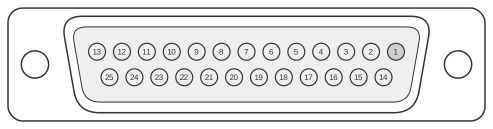 25 PIN D-SUB FEMALE to Computer
| Name | Pin | Pin | Pin |
|---|---|---|---|
| Jumpering 1 | 2 | 3 | |
| Jumpering 2 | 4 | 5 | |
| Jumpering 3 | 6 | 8 | 20 |
Signals
- Jumpering 1 (pins 2–3) — bridges TxD (Transmitted Data) to RxD (Received Data); data sent by the UART is looped back as received data.
- Jumpering 2 (pins 4–5) — bridges RTS (Request To Send) to CTS (Clear To Send); loops the flow-control handshake pair.
- Jumpering 3 (pins 6–8–20) — ties DSR (Data Set Ready), DCD (Data Carrier Detect), and DTR (Data Terminal Ready) together; loops the modem-ready signal group.
Notes
- The loopback plug uses a female DB-25 connector to mate with the male DB-25 serial port on the host PC, as RS-232 specifies DTE ports with male connectors.
- Ring Indicator (RI, pin 22) is not bridged in this wiring scheme; some diagnostic tools that test RI will report that signal separately or skip it.
- The wiring pattern (pins 2–3, 4–5, 6–8–20) is consistent with the standard DB-25 RS-232 loopback scheme documented by PC-Doctor and Oracle/Sun diagnostic references.
References
- Serial and Parallel Port External Loopback Wiring Diagrams — PC-Doctor, Inc.
- SunVTS 6.2 Test Reference Manual — Appendix A: Loopback Connectors — Oracle Corporation
- SunVTS 3.0 Test Reference Manual — Appendix A: Loopback Connectors — Oracle Corporation