
A serial-port loopback plug (also called a wrap plug) is a diagnostic connector that shorts a serial port’s transmit outputs back to its receive inputs, enabling software to verify UART hardware without any external device. The 25-pin variant uses a DB-25 female connector mating with the male DB-25 RS-232 port found on older XT-era PCs and peripheral equipment. Wiring follows the RS-232 standard (ANSI/TIA/EIA-232-F) and loops the three principal signal groups: data (TxD/RxD), flow control (RTS/CTS), and modem-control (DSR/DCD/DTR/RI). This configuration is associated with the CheckIt diagnostic software from TouchStone Software.
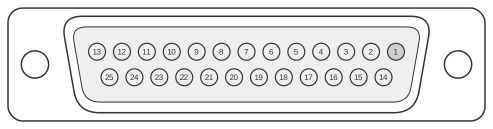 25 PIN D-SUB FEMALE to Computer
| Name | Pin | Pin | Pin | Pin |
|---|---|---|---|---|
| Jumpering 1 | 2 | 3 | ||
| Jumpering 2 | 4 | 5 | ||
| Jumpering 3 | 6 | 8 | 20 | 22 |
Signals
- Jumpering 1 — shorts pin 2 (RxD, Receive Data) to pin 3 (TxD, Transmit Data), looping the data path back to the transmitter
- Jumpering 2 — shorts pin 4 (RTS, Request to Send) to pin 5 (CTS, Clear to Send), looping the hardware flow-control signals
- Jumpering 3 — shorts pin 6 (DSR, Data Set Ready), pin 8 (DCD, Data Carrier Detect), pin 20 (DTR, Data Terminal Ready), and pin 22 (RI, Ring Indicator) together, looping the full modem-control group
Notes
The plug uses a DB-25 female connector and mates directly with the male DB-25 serial port on the PC; no cable is required. The inclusion of pin 22 (RI) in the modem-control group distinguishes the CheckIt 25-pin wiring from the PC-Doctor variant, which omits RI. The standard RS-232 DB-25 core loops pins 2–3 (data), 4–5 (flow control), and 6–8–20 (modem control); this plug extends the modem-control group with pin 22.