
A 25-pin DB-25 serial loopback plug is a diagnostic connector used to test RS-232 serial ports by routing the port’s transmit outputs back to its receive inputs, allowing diagnostic software to verify UART operation without an external device. The governing electrical standard is ANSI/TIA/EIA-232-F (RS-232); the 25-pin DB-25 connector was the original IBM PC serial interface, predating the 9-pin DE-9 form introduced with the PC/AT in 1984. Norton Diagnostics (Symantec) used this wiring to exercise the data, flow-control, and modem-control signal groups of the serial port. The wiring loops pin 2 to pin 3 (TxD–RxD), pin 4 to pin 5 (RTS–CTS), and groups pins 6, 8, 20, and 22 together (DSR, DCD, DTR, and RI).
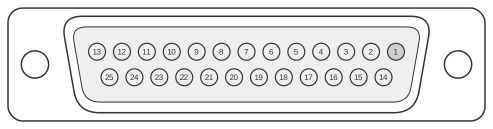 25 PIN D-SUB FEMALE to Computer
| Name | Pin | Pin | Pin | Pin |
|---|---|---|---|---|
| Jumpering 1 | 2 | 3 | ||
| Jumpering 2 | 4 | 5 | ||
| Jumpering 3 | 6 | 8 | 20 | 22 |
Signals
- Pin 2 (TxD) / Pin 3 (RxD) — Transmit Data looped to Receive Data; the core data path test.
- Pin 4 (RTS) / Pin 5 (CTS) — Request to Send looped to Clear to Send; tests flow-control handshake.
- Pin 6 (DSR) / Pin 8 (DCD) / Pin 20 (DTR) / Pin 22 (RI) — Data Set Ready, Data Carrier Detect, Data Terminal Ready, and Ring Indicator shorted together; tests the modem-control signal group including RI.
Notes
The plug uses a female DB-25 connector to mate with the male DB-25 serial port on older PC hardware. The inclusion of Ring Indicator (pin 22) in the modem-control group distinguishes the Norton Diagnostics wiring from simpler three-group loopbacks that omit RI. The RS-232 standard specifies DTE ports as male connectors; the loopback plug is therefore female.